Reviews reflect personal experiences and are not medical advice. Always consult your doctor.
About This Product
Manufacturer
Eli Lilly Nederland B.V. (Hiszpania)
Composition
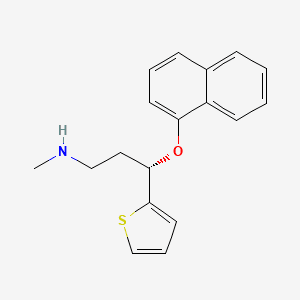
Duloxetinum 60 mg
ATC Code
N06AX21
Source
URPL
Pharmacotherapeutic group: Other antidepressants. ATC code: N06AX21.
Mechanism of action
Duloxetine is a combined serotonin (5-HT) and noradrenaline (NA) reuptake inhibitor. It weakly inhibits dopamine reuptake with no significant affinity for histaminergic, dopaminergic, cholinergic and adrenergic receptors. Duloxetine dose-dependently increases extracellular levels of serotonin and noradrenaline in various brain areas of animals.
Pharmacodynamic effects
Duloxetine normalised pain thresholds in several preclinical models of neuropathic and inflammatory pain and attenuated pain behaviour in a model of persistent pain. The pain inhibitory action of duloxetine is believed to be a result of potentiation of descending inhibitory pain pathways within the central nervous system.
Clinical efficacy and safety
Major Depressive Disorder:
Cymbalta was studied in a clinical programme involving 3,158 patients (1,285 patient-years of exposure) meeting DSM-IV criteria for major depression. The efficacy of Cymbalta at the recommended dose of 60 mg once a day was demonstrated in three out of three randomised, double-blind, placebo-controlled, fixed dose acute studies in adult outpatients with major depressive disorder. Overall, Cymbalta's efficacy has been demonstrated at daily doses between 60 and 120 mg in a total of five out of seven randomised, double-blind, placebo-controlled, fixed dose acute studies in adult outpatients with major depressive disorder.
Cymbalta demonstrated statistical superiority over placebo as measured by improvement in the 17 item Hamilton Depression Rating Scale (HAM-D) total score (including both the emotional and somatic symptoms of depression). Response and remission rates were also statistically significantly higher with Cymbalta compared with placebo. Only a small proportion of patients included in pivotal clinical trials had severe depression (baseline HAM-D >25).
In a relapse prevention study, patients responding to 12 weeks of acute treatment with open-label Cymbalta 60 mg once daily were randomised to either Cymbalta 60 mg once daily or placebo for a further 6 months. Cymbalta 60 mg once daily demonstrated a statistically significant superiority compared to placebo (p = 0.004) on the primary outcome measure, the prevention of depressive relapse, as measured by time to relapse. The incidence of relapse during the 6-months double-blind, follow-up period was 17% and 29% for duloxetine and placebo, respectively.
During 52 weeks of placebo-controlled double-blind treatment, duloxetine-treated patients with recurrent MDD had a significantly longer symptom free period (p<0.001) compared with patients randomised to placebo. All patients had previously responded to duloxetine during open-label duloxetine treatment (28 to 34 weeks) at a dose of 60 to 120 mg/day. During the 52-week placebo-controlled double-blind treatment phase, 14.4% of the duloxetine-treated patients and 33.1% of the placebo-treated patients experience a return of their depressive symptoms (p<0.001).
The effect of Cymbalta 60 mg once a day in elderly depressed patients (≥65 years) was specifically examined in a study that showed a statistically significant difference in the reduction of the HAM-D17 score for duloxetine-treated patients compared to placebo. Tolerability of Cymbalta 60 mg once daily in elderly patients was comparable to that seen in the younger adults. However, data on elderly patients exposed to the maximum dose (120 mg per day) are limited and thus, caution is recommended when treating this population.
Generalised Anxiety Disorder:
Cymbalta demonstrated statistically significant superiority over placebo in five out of five studies including four randomised, double-blind, placebo-controlled acute studies and a relapse prevention study in adult patients with generalised anxiety disorder.
Cymbalta demonstrated statistically significant superiority over placebo as measured by improvement in the Hamilton Anxiety Scale (HAM-A) total score and by the Sheehan Disability Scale (SDS) global functional impairment score. Response and remission rates were also higher with Cymbalta compared to placebo. Cymbalta showed comparable efficacy results to venlafaxine in terms of improvements on the HAM-A total score.
In a relapse prevention study, patients responding to 6 months of acute treatment with open-label Cymbalta were randomised to either Cymbalta or placebo for a further 6 months. Cymbalta 60 mg to 120 mg once daily demonstrated statistically significant superiority compared to placebo (p<0.001) on the prevention of relapse, as measured by time to relapse. The incidence of relapse during the 6-months double-blind follow-up period was 14% for Cymbalta and 42% for placebo.
The efficacy of Cymbalta 30-120 mg (flexible dosing) once a day in elderly patients (>65 years) with generalised anxiety disorder was evaluated in a study that demonstrated statistically significant improvement in the HAM-A total score for duloxetine-treated patients compared to placebo-treated patients. The efficacy and safety of Cymbalta 30-120 mg once daily in elderly patients with generalised anxiety disorder was similar to that seen in studies of younger adult patients. However, data on elderly patients exposed to the maximum dose (120 mg per day) are limited and, thus, caution is recommended when using this dose with the elderly population.
Diabetic Peripheral Neuropathic Pain:
The efficacy of Cymbalta as a treatment for diabetic neuropathic pain was established in 2 randomised, 12-week, double-blind, placebo-controlled, fixed-dose studies in adults (22 to 88 years) having diabetic neuropathic pain for at least 6 months. Patients meeting diagnostic criteria for major depressive disorder were excluded from these trials. The primary outcome measure was the weekly mean of 24-hour average pain, which was collected in a daily diary by patients on an 11-point Likert scale.
In both studies, Cymbalta 60 mg once daily and 60 mg twice daily significantly reduced pain compared with placebo. The effect in some patients was apparent in the first week of treatment. The difference in mean improvement between the two active treatment arms was not significant. At least 30% reported pain reduction was recorded in approximately 65% of duloxetine-treated patients versus 40% for placebo. The corresponding figures for at least 50% pain reduction were 50% and 26% respectively. Clinical response rates (50% or greater improvement in pain) were analysed according to whether or not the patient experienced somnolence during treatment. For patients not experiencing somnolence, clinical response was observed in 47% of patients receiving duloxetine and 27% of patients on placebo. Clinical response rates in patients experiencing somnolence were 60% on duloxetine and 30% on placebo. Patients not demonstrating a pain reduction of 30% within 60 days of treatment were unlikely to reach this level during further treatment.
In an open-label, long-term uncontrolled study, the pain reduction in patients responding to 8 weeks of acute treatment of Cymbalta 60 mg once daily was maintained for a further 6 months as measured by change on the Brief Pain Inventory (BPI) 24-hour average pain item.
Paediatric population
Duloxetine has not been studied in patients under the age of 7. Two randomised, double-blind, parallel clinical trials were performed in 800 paediatric patients aged 7 to 17 years with major depressive disorder (see section 4.2). These two studies included a 10-week placebo and active (fluoxetine) controlled acute phase followed by six months period of active controlled extension treatment. Neither duloxetine (30-120 mg) nor the active control arm (fluoxetine 20-40 mg) statistically separated from placebo on change from baseline to endpoint in the Children´s Depression Rating Scale-Revised (CDRS-R) total score. Discontinuation due to adverse events was higher in patients taking duloxetine compared with those treated with fluoxetine, mostly due to nausea. During the 10-week acute treatment period, suicidal behaviours were reported (duloxetine 0/333 [0%], fluoxetine 2/225 [0.9%], placebo 1/220 [0.5%]). Over the entire 36-week course of the study, 6 out of 333 patients initially randomised to duloxetine and 3 out of 225 patients initially randomised to fluoxetine experienced suicidal behaviour (exposure adjusted incidence 0.039 events per patient year for duloxetine and 0.026 for fluoxetine). In addition, one patient who transitioned from placebo to duloxetine experienced a suicidal behaviour while taking duloxetine.
A randomised, double-blind, placebo-controlled study was performed in 272 patients aged 7-17 years with generalised anxiety disorder. The study included a 10 week placebo-controlled acute phase, followed by an 18 week extension treatment period. A flexible dose regimen was used in this study, to allow for slow dose escalation from 30 mg once daily to higher doses (maximum 120 mg once daily). Treatment with duloxetine showed a statistically significantly greater improvement in GAD symptoms, as measured by PARS severity score for GAD (mean difference between duloxetine and placebo of 2.7 points [95% CI 1.3-4.0]), after 10 weeks of treatment. The maintenance of the effect has not been evaluated. There was no statistically significant difference in discontinuation due to adverse events between duloxetine and placebo groups during the 10-week acute treatment phase. Two patients who transitioned from placebo to duloxetine after the acute phase experienced suicidal behaviours while taking duloxetine during the extension phase. A conclusion on the overall benefit/risk in this age group has not been established (see also sections 4.2 and 4.8).
A single study has been performed in paediatric patients with juvenile primary fibromyalgia syndrome (JPFS) in which the duloxetine-treated group did not separate from placebo group for the primary efficacy measure. Therefore, there is no evidence of efficacy in this paediatric patient population. The randomised, double-blind, placebo-controlled, parallel study of duloxetine was conducted in 184 adolescents aged 13 to 18 years (mean age 15.53 years) with JPFS. The study included a 13-week double-blind period where patients were randomised to duloxetine 30 mg/60 mg, or placebo daily. Duloxetine did not show efficacy in reducing pain as measured by primary outcome measure of Brief Pain Inventory (BPI) average pain score endpoint: least squares (LS) mean change from baseline in BPI average pain score at 13 weeks was -0.97 in the placebo group, compared with -1.62 in the duloxetine 30/60 mg group (p = 0.052). The safety results from this study were consistent with the known safety profile of duloxetine.
The European Medicines Agency has waived the obligation to submit the results of studies with Cymbalta in all subsets of the paediatric population in the treatment of major depressive disorder, diabetic neuropathic pain and generalised anxiety disorder. See section 4.2 for information on paediatric use.