This information is for educational purposes only. It is not intended as medical advice. Always consult a qualified healthcare professional.
Eladynos — Description, Dosage, Side Effects | PillsCard
OTC
Eladynos
2 mg/ml, Roztwór do wstrzykiwań we wstrzykiwaczu
INN: Abaloparatidum
Data updated: 2026-04-13
Available in:
🇨🇿🇩🇪🇬🇧🇫🇷🇵🇱🇸🇰🇺🇦
Form
Roztwór do wstrzykiwań we wstrzykiwaczu
Dosage
2 mg/ml
Route
podskórna
Storage
—
About This Product
User Reviews
Reviews reflect personal experiences and are not medical advice. Always consult your doctor.
Manufacturer
Theramex Ireland Limited (Polska)
Composition
Abaloparatidum 2 mg/ml
ATC Code
H05AA04
Source
URPL
Pharmacotherapeutic group: Calcium homeostasis, parathyroid hormones and analogues, ATC code: H05AA04
Mechanism of action
Abaloparatide is a 34 amino acid peptide that shares 41% homology to parathyroid hormone [PTH(1-34)] and 76% homology to parathyroid hormone related peptide [PTHrP(1-34)], and is an activator of the PTH1 receptor signalling pathway. Abaloparatide stimulates new bone formation on trabecular and cortical bone surfaces by stimulation of osteoblastic activity.
Abaloparatide causes transient and limited increases in bone resorption and increases bone density.
Clinical efficacy and safety
The efficacy and safety of once daily abaloparatide was evaluated in a randomised, multicentre, double-blind, placebo- and open-label active comparator-controlled (teriparatide) clinical study (ACTIVE study) for 18 months of treatment with 1 month follow-up in 2 070 postmenopausal women aged 50 to 86 years (mean age of 69; 15% were <65 years of age, 65% were 65 to ˂75 years of age, and 20% were ≥75 years of age) who were enrolled and randomised to receive abaloparatide 80 micrograms (N=696), placebo (N=688), or 20 micrograms teriparatide (N=686). Approximately 76% of patients were Caucasian, 19% were Asian, and 4% were Black. Of the total study population, 28% were Hispanic. Women took daily supplemental calcium (500 to 1 000 mg) and vitamin D (400 to 800 IU) per day. The primary endpoint in ACTIVE was the incidence of new vertebral fractures in abaloparatide-treated patients versus placebo.
At baseline, the mean T-scores were -2.9 at the lumbar spine, -2.2 at the femoral neck, and -1.9 at the total hip. At baseline, 42% of patients had no prior fracture, 23% of patients had at least one prevalent vertebral fracture, and 43% had at least one prior non-vertebral fracture.
Effect on new vertebral fractures
In the ACTIVE study at 18 months, abaloparatide and teriparatide significantly reduced the absolute risk of new vertebral fractures versus placebo in postmenopausal patients with osteoporosis (p<0.0001; see Table 2).
Table 2 – ACTIVE Trial: the effect* of abaloparatide on the risk of new vertebral fracture at 18 months
Parameter
PBO
(N=600)
ABL
(N=583)
TER
(N=600)
Number of women with vertebral fracture, n (%)
25 (4.2)
3 (0.5)
4 (0.7)
Absolute risk difference vs placebo
†
(%)
(95% CI)
n/a
3.7 (2.0, 5.6)
3.5 (1.8, 5.5)
*Based on Modified Intent to Treat Population (patients with baseline and post-baseline spine radiographs).
†
Absolute risk difference was calculated as (PBO – ABL) and (PBO – TER).
PBO=placebo, ABL=abaloparatide, TER=teriparatide, CI=confidence interval
Effect on non-vertebral fractures
In the ACTIVE study at 19 months, the incidence of non-vertebral fractures was similar between the abaloparatide (2.7%) and teriparatide (2.0%) groups, and not statistically different compared to placebo (3.6%) (see Table 3).
Table 3 – ACTIVE Trial: time-to-event of non-vertebral fracture at 19 months
Parameter
PBO
(N=688)
ABL
(N=696)
TER
(N=686)
K-M estimated event rate (%)
(95% CI)
3.6
(2.3, 5.4)
2.7
(1.6, 4.4)
2.0
(1.1, 3.4)
Number of patients with event
n (%)
21 (3.1)
15 (2.2)
12 (1.7)
Absolute risk difference vs placebo* (%)
(95% CI)
n/a
0.9
(-1.1, 2.9)
1.6
(-0.3, 3.5)
*Absolute risk difference was calculated as (PBO – ABL) and (PBO – TER).
PBO=placebo, ABL= abaloparatide, TER=teriparatide, K-M=Kaplan Meier, CI=confidence interval
Effect on bone mineral density (BMD)
In the ACTIVE study, abaloparatide significantly increased BMD at all anatomical sites measured, versus placebo at 6, 12 and 18 months. The mean percent change in BMD at 18 months was 9.1% vs 0.5% at the lumbar spine, 3.3% vs 0% at the total hip, and 2.7% vs -0.4% at the femoral neck for abaloparatide versus placebo groups, respectively (all p<0.0001). At the ultra-distal radius, the mean percent change in BMD at 18 months was 1.2% vs -1.0% for abaloparatide versus placebo groups.
Abaloparatide demonstrated consistent increases in BMD measurements regardless of age, years since menopause, race, geographic region, presence or absence of prior fracture (vertebral, non-vertebral), severity of disease, and BMD at baseline.
Bone turnover markers
In postmenopausal women with osteoporosis, the bone anabolic marker (s-PINP) showed a 90% increase above baseline at 1 month, and this effect was sustained throughout the abaloparatide treatment period. The bone resorption marker (s-CTX) showed no increase at 1 month, and a transient 22% increase above baseline at 3 months that returned to baseline at the end of treatment.
Post treatment management
Extension study
Upon completion of the ACTIVE trial, 963 patients, enrolled in the ACTIVExtend trial, an open-label extension study, where all patients received up to 24 months of treatment with 70 mg alendronate (ALN) weekly and calcium and vitamin D supplements. This included 494 patients who had previously received placebo and 469 patients who had previously received abaloparatide. Patients who received teriparatide during the ACTIVE trial were not eligible to participate in the ACTIVExtend trial. Results for vertebral fracture risk reduction at 43 months since randomisation are presented in Table 4.
Effect on new vertebral fractures – Extension study
In the ACTIVExtend study at 43 months, abaloparatide/ALN significantly reduced the absolute risk of new vertebral fractures vs placebo/ALN (p<0.0001; see Table 4). Teriparatide followed by alendronate has not been studied.
Table 4 – ACTIVExtend trial: the effect* of abaloparatide/ALN on the risk of new vertebral fracture at 43 months
†
Parameter
PBO/ALN
(N=489)
ABL/ALN
(N=457)
Number of women with vertebral fracture, n (%)
26 (5.3)
4 (0.9)
Absolute risk difference vs placebo/ALN
‡
(%)
(95% CI)
n/a
4.4
(2.3, 6.9)
*Based on Modified Intent to Treat Population (patients with baseline and post-baseline spine radiographs).
†
Alendronate started at 19 months
‡
Absolute risk difference was calculated as (PBO/ALN – ABL/ALN).
PBO=placebo, ABL=abaloparatide, ALN=alendronate, CI=confidence interval
Effect on non-vertebral fractures – Extension study
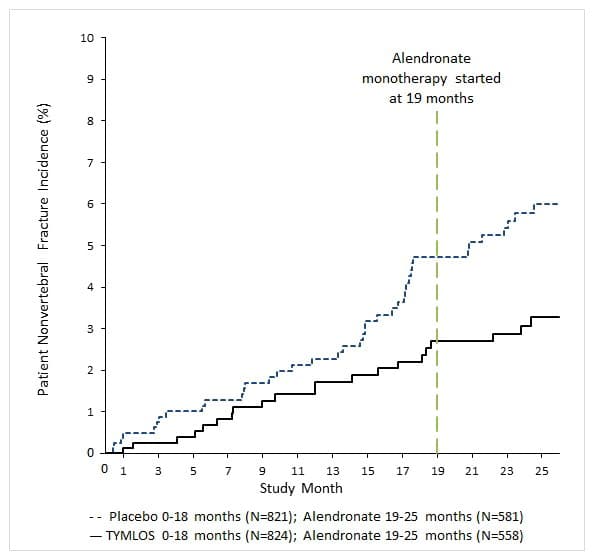
In the ACTIVExtend study at 43 months, abaloparatide/ALN numerically reduced the risk of non-vertebral fractures versus placebo/ALN. The incidence of non-vertebral fractures with abaloparatide/ALN (4.2%) was not statistically different compared to placebo (6.7%) (see Table 5).
Table 5 – ACTIVExtend trial: time-to-event of non-vertebral fracture at 43 months*
Parameter
PBO/ALN
(N=494)
ABL/ALN
(N=469)
K-M estimated event rate (%)
(95% CI)
6.7
(4.8, 9.3)
4.2
(2.7, 6.4)
Number of patients with event
n (%)
32 (6.5)
19 (4.1)
Absolute risk difference vs placebo/ALN
†
(%)
(95% CI)
n/a
2.5
(-0.4, 5.4)
*Alendronate started at 19 months
†
Absolute risk difference was calculated as (PBO/ALN – ABL/ALN).
PBO=placebo, ABL=abaloparatide, ALN=alendronate, K-M=Kaplan Meier, CI=confidence interval
Effect on bone mineral density (BMD) – Extension study
The mean percent change in BMD through 43 months was 14.7% vs 6.8% at the lumbar spine, 6.3% vs 2.9% at the total hip, 5.0% vs 1.6% at the femoral neck, and 1.1% vs 1.1% at the ultra-distal radius for abaloparatide/ALN versus placebo/ALN groups, respectively.
Paediatric population
The European Medicines Agency has waived the obligation to submit the results of studies with abaloparatide in all subsets of the paediatric population in the treatment of osteoporosis (see section 4.2 for information on paediatric use).
⚠️ Warnings
Each pen should be used by only one patient. A new, sterile needle must be used for every injection. The pen should only be used with 8 mm, 31-gauge needles. No needles are supplied with the medicinal product. Do not store the pen with the needle attached.
Eladynos should not be used if the solution is cloudy, coloured or contains particles.
Before using the pen device for the first time, the patient should read and understand the instructions on how to use the pen. A detailed Instructions for Use is provided with the pen in the carton.
Injecting Eladynos
Step 1 Check the Eladynos pen
Before using the pen always check the label to be sure it is the correct pen.
Make note of the date of Day 1 in the space provided on the carton. Do not use the pen for more than 30 consecutive days.
Dispose of the pen 30 days after first use.
Pull off the pen cap from the pen.
Check the Eladynos cartridge.
The liquid should be clear, colourless, and free of particles; if not, do not use. Small air bubbles may be present in the liquid; this is normal.
Step 2
Attach needle to the Eladynos pen
Remove the protective paper from a new needle.
Push the capped needle straight
onto the pen and
twist until it is secure
. Make sure the needle is straight so that it doesn't bend when inserting. The pen will not work if the needle is not properly attached. Do not over-tighten as this may make the needle difficult to remove.
Pull off the
outer needle cap
from the needle and keep it to use after the injection.
Carefully pull off the
inner needle cap
and dispose of it.
Step 3
Day 1 Only – Testing an Eladynos pen prior to first injection
The pen has
medicine for 30 days
and a small amount to test each pen
once
, to confirm it is working properly.
Attention:
If the patient tests the pen before every injection, then the pen will run out of medicine early.
Therefore, perform Step 3 once for each pen, only on Day 1
, prior to first injection.
For
Day 2 through Day 30
, do not test the pen again,
go directly to Step 4 to set the dose for the injection.
Turn the dose knob
on the pen away from you (clockwise) until it stops.
“•80” will be lined up
in the dose display window.
Hold the pen with the pen needle pointing up.
Press the green injection button
until it will not go any further.
Liquid, as a drop or stream, come out of the needle tip
. If no liquid appears, see Troubleshooting in the “Instructions for use” at the end of the package leaflet.
“ ●0” will be lined up
in the dose display window.
Step 4 Set the dose on the Eladynos pen
Turn the white knob
on the pen away from you (clockwise) until the knob stops and
“●80” is lined up in the display window
. The pen is now ready for injection.
Step 5 Choose and clean the injection site
Injections should be given in the lower abdomen. Avoid the 5 cm area around your belly button (navel).
For each injection, select a different injection site on the abdomen each day. Only inject into clear skin. Do not inject into areas on the abdomen where the skin is tender, bruised, red, scaly, or hard. Avoid areas with scars or stretch marks.
Wipe the injection site with an alcohol swab
and allow it to dry.
Do not touch, fan, or blow on the injection site after it has been cleaned.
Note: It may be recommended to pinch up the skin at the site where the injection will occur. Once the needle enters the skin, the pinch can be released.
Step 6 Giving your Eladynos pen injection
Insert the needle
straight into your skin.
Press and HOLD the green button
until ALL
events below are complete and
“●0” is displayed.
Hold for 10 seconds
to give full dose,
withdraw pen from skin,
and
THEN release the button.
Step 7 Remove the pen needle
Carefully
place the outer needle cap back on the needle
. Then carefully press on the outer needle cap until it snaps into place and is secure.
Unscrew the capped needle
(like unscrewing a cap from a bottle). To unscrew the capped needle, squeeze the cap at the base against the needle and turn it 8 or more turns and then gently pull until the capped needle comes off.
Note: Do not push down on the outer needle cap while unscrewing the needle.
Note: You should see a gap widening between the outer needle cap and the pen as you unscrew the needle.
Step 8 After your injection
Firmly
replace the pen cap
onto the pen.
Keep the pen cap on your Eladynos pen between injections.
The patient may have slight bleeding, this is normal. Do not rub the injection site. If slight bleeding occurs, press a cotton ball or gauze pad as needed to stop the bleeding. The patient may also cover the injection site with a small adhesive bandage.
Any unused medicinal product or waste material should be disposed of in accordance with local requirements.