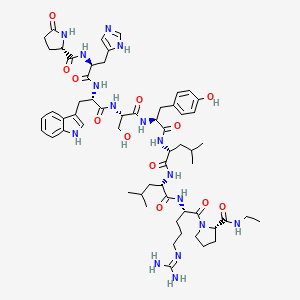
Pharmacotherapeutic group: hormonal agents used in oncology, gonadotropin-releasing hormone analogues; ATC code: L02AE02
Mechanism of action
Leuprorelin mesilate is a synthetic nonapeptide agonist of the naturally occurring hormone GnRH which, when administered continuously, inhibits pituitary secretion of gonadotropins and suppresses testicular steroidogenesis in men. This effect is reversible on discontinuation of treatment. The agonist is, however, more potent than the natural hormone, and the time to recovery of testosterone to baseline levels may vary between individual patients.
Pharmacodynamic effects
Administration of leuprorelin produces an initial rise in circulating luteinising hormone (LH) and follicle-stimulating hormone (FSH), which in men leads to a transient increase in the gonadal steroids testosterone and dihydrotestosterone. Continuous administration of leuprorelin results in a fall in LH and FSH levels. In men, testosterone is reduced below the castration threshold (≤ 50 ng/dl).
Following the first dose of leuprorelin, the mean serum testosterone concentration rose transiently and then fell below the castration threshold (≤ 50 ng/dl) within 3–4 weeks, remaining below the castration threshold throughout six months of administration of the medicinal product (Figure 1 below).
Long-term studies have shown that continued treatment maintains testosterone below the castration threshold for up to seven years and, in all likelihood, indefinitely thereafter.
Tumour size was not measured directly during the clinical development programme; however, an indirect favourable tumour response was observed, as evidenced by a 97% reduction in mean PSA levels with leuprorelin administration.
In a randomised phase III clinical study enrolling 970 patients with locally advanced prostate cancer (predominantly patients with clinical stage T2c to T4 disease and a small number of patients with pathological regional nodal disease of clinical stage T1c to T2b), of whom 483 were assigned to short-term androgen deprivation (6 months) combined with radiotherapy and 487 to long-term treatment (3 years), short-term and long-term concomitant and adjuvant hormonal therapy with GnRH agonists (triptorelin or goserelin) were compared in a non-inferiority analysis. Overall five-year mortality was 19% in the short-term treatment group and 15.2% in the long-term treatment group. The observed hazard ratio of 1.42, with an upper one-sided 95.71% CI of 1.79 or a two-sided 95.71% CI of 1.09; 1.85 (p = 0.65 for demonstration of non-inferiority), indicates that radiotherapy combined with six months of androgen deprivation therapy results in poorer survival compared with radiotherapy combined with three years of androgen deprivation therapy. Overall five-year survival reached 84.8% in the long-term treatment group and 81.0% in the short-term treatment group. Overall quality of life, assessed using the QLQ-C30 quality-of-life questionnaire, did not differ significantly between the two groups (p = 0.37). The results are dominated by data from the population of patients with locally advanced tumours.
Evidence for the indication in high-risk localised prostate cancer is derived from published radiotherapy studies in combination with GnRH analogues, including leuprorelin. Data from five published clinical studies (EORTC 22863, RTOG 85-31, RTOG 92-02, RTOG 8610 and D'Amico et al., JAMA, 2004) were analysed, all of which demonstrate a benefit of combining GnRH analogues with radiotherapy. A clear distinction of the target population for the indication of locally advanced prostate cancer versus high-risk localised prostate cancer was not possible in the published studies.
Clinical data show that radiotherapy followed by three years of androgen deprivation therapy is preferable to radiotherapy followed by six months of androgen deprivation therapy. The recommended duration of androgen deprivation therapy in treatment guidelines for patients with clinical stage T3–T4 disease undergoing radiotherapy is 2–3 years.
Clinical efficacy and safety of CAMCEVI
A multicentre, single-arm, open-label, 48-week phase 3 study investigating leuprorelin enrolled 137 male patients with high-risk localised and locally advanced prostate cancer requiring androgen deprivation therapy. The efficacy of the medicinal product (two doses administered 24 weeks apart) was assessed by the percentage of subjects in whom serum testosterone was reduced to the castration threshold, the effect on serum LH as a measure of testosterone regulation, and the effect on serum PSA.
The percentage of patients achieving serum testosterone below the castration threshold (≤ 50 ng/dl) by Day 28 was 98.5% (135 of 137 patients; randomised according to the intention-to-treat principle) and 99.2% (123 of 124 subjects; per-protocol population) (Figure 1).
Days
Serum testosterone level (ng/dl)
Figure 1: Mean serum testosterone concentration during treatment with CAMCEVI over time (n = 124; per-protocol population)
The dashed line indicates the castration level (50 ng/dl) of serum testosterone.
Following the first injection, mean serum LH fell significantly, and this effect persisted until the end of the study (98% decrease from baseline [Day 336]).
Tumour size was not measured directly in this study, but an indirect favourable tumour response can be assumed with leuprorelin, as evidenced by a significant reduction in mean PSA over time after injection of this medicinal product (a mean value of 70 ng/ml at baseline fell to a mean nadir value of 2.6 ng/ml by Day 168 [per-protocol population]).
Paediatric population
The European Medicines Agency has waived the obligation to submit the results of studies with a reference medicinal product containing leuprorelin in all subsets of the paediatric population in prostate cancer (for information on paediatric use, see section 4.2).
⚠️ Warnings
Androgen deprivation therapy may prolong the QT interval
Before initiating treatment with leuprorelin, the physician should consider the benefit/risk balance, including the risk of torsade de pointes, in patients with a history of risk factors for QT prolongation and in patients receiving concomitant medicinal products that may prolong the QT interval (see section 4.5). Periodic monitoring of ECG and electrolyte concentrations should be considered.
Cardiovascular disease
An increased risk of myocardial infarction, sudden cardiac death and stroke has been reported in association with the use of GnRH agonists in men. Based on the reported odds ratios, the risk appears to be low and should be carefully evaluated together with cardiovascular risk factors when determining treatment for patients with prostate cancer. Patients treated with GnRH agonists should be monitored for symptoms and signs suggestive of the development of cardiovascular disease and managed according to current clinical practice.
Transient increase in testosterone levels
Leuprorelin, like other GnRH agonists, causes a transient increase in serum concentrations of testosterone, dihydrotestosterone and acid phosphatase during the first week of treatment. Patients may experience a worsening of symptoms or the appearance of new symptoms, including bone pain, neuropathy, haematuria, or obstruction of the ureters or bladder outlet (see section 4.8). These symptoms usually subside with continued treatment.
Supplementary administration of a suitable antiandrogen should be considered, starting 3 days before initiation of leuprorelin treatment and continuing during the first two to three weeks of treatment. This measure has been reported to protect against the consequences of the initial rise in serum testosterone.
Administration of leuprorelin after surgical castration no longer leads to a further reduction in serum testosterone in men.
Bone density
Bone thinning has been described in the medical literature in men following castration or in men treated with GnRH agonists (see section 4.8).
Treatment with antiandrogens significantly increases the risk of fractures due to osteoporosis. Only limited data are available regarding this problem. Fractures due to osteoporosis were observed in 5% of patients after 22 months of pharmacological androgen deprivation therapy and in 4% of patients after 5 to 10 years of this treatment. The risk of fractures due to osteoporosis is generally higher than the risk of pathological fractures.
In addition to long-term testosterone deficiency, older age, smoking and alcohol consumption, obesity, and lack of physical activity may also contribute to the development of osteoporosis.
Pituitary apoplexy
During post-marketing surveillance, rare cases of pituitary apoplexy (a clinical syndrome associated with pituitary infarction) have been reported following administration of GnRH agonists. Most symptoms appeared within 2 weeks of the first dose, some within the first hour. In these cases, pituitary apoplexy presented with sudden headache, vomiting, visual changes, ophthalmoplegia, changes in mental status, and sometimes cardiovascular collapse. The condition requires immediate medical intervention.
Metabolic changes
Hyperglycaemia and an increased risk of developing diabetes have been reported in men receiving GnRH agonists. Hyperglycaemia may represent the development of diabetes mellitus or a worsening of glycaemic control in patients with diabetes. Blood glucose and/or glycosylated haemoglobin (HbA1c) should be measured periodically in patients receiving GnRH agonists, and management should follow current practice for the treatment of hyperglycaemia or diabetes. Metabolic changes associated with GnRH agonists may also include hepatic steatosis.
Epileptic seizures
Convulsions have been observed from post-marketing reports in patients treated with leuprorelin, with or without a history of predisposing factors (see section 4.8). If convulsions occur, management should follow current clinical practice.
Idiopathic intracranial hypertension
Idiopathic intracranial hypertension (pseudotumour cerebri) has been reported in patients receiving leuprorelin. Patients should be warned about the signs and symptoms of idiopathic intracranial hypertension, including severe or recurrent headache, visual disturbances and tinnitus. If idiopathic intracranial hypertension occurs, discontinuation of leuprorelin should be considered.
Severe cutaneous adverse reactions
Severe cutaneous adverse reactions (SCAR), including Stevens-Johnson syndrome (SJS) and toxic epidermal necrolysis (TEN), which may be life-threatening or fatal, have been reported in association with leuprorelin treatment. When prescribing this product, patients must be warned about the possible signs and symptoms of severe cutaneous reactions and should be closely monitored. If signs and symptoms suggestive of these reactions appear, leuprorelin should be discontinued immediately and (as required) an alternative treatment should be considered.
Other events
Cases of ureteral obstruction and spinal cord compression, which may contribute to paralysis with or without fatal complications, have been reported with the administration of GnRH agonists. If spinal cord compression or renal impairment develops, standard treatment of these complications must be initiated.
Patients with vertebral and/or cerebral metastases and patients with urinary tract obstruction should be closely monitored during the first few weeks of treatment.