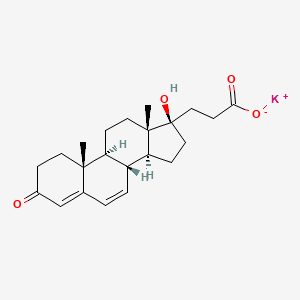
Pharmacotherapeutic group: potassium-sparing diuretics, ATC code: C03D A02
Mechanism of action
Potassium canrenoate competitively blocks the binding of aldosterone to cytoplasmic receptors of tubular cells in the collecting duct of the kidneys. Aldosterone is thus unable to induce the synthesis and activation of enzymes responsible for the active secretion of potassium into urine and the reabsorption of sodium.
Potassium canrenoate increases the excretion of sodium and chloride ions, and to a lesser extent, calcium excretion. Potassium and ammonium excretion is reduced, and urine acidity decreases. Potassium canrenoate also reduces the renal excretion of magnesium.
Aldosterone receptors have been found both in renal and extrarenal tissues (e.g., in the pancreas and intestine). Potassium canrenoate acts only in the presence of endogenous or exogenous aldosterone. Its effect can be abolished by high aldosterone levels. Neither the production nor excretion of aldosterone is reduced at therapeutic doses. Only at extremely high doses does potassium canrenoate inhibit its biosynthesis.
When used alone, potassium canrenoate has only a negligible diuretic effect. Natriuresis can be enhanced by a supplementary dose of thiazide or loop diuretics. The diuretic effect occurs within the first 3–6 hours after parenteral administration, depending on the degree of pre-existing hyperaldosteronism, and may persist for up to 72 hours.
⚠️ Warnings
Special attention during treatment with Aldactone must be given to patients at risk of developing hyperkalaemia due to their underlying condition, such as impaired renal function and diabetes mellitus (diabetic nephropathy). In patients with hepatic insufficiency, worsening of hepatic encephalopathy may occur during treatment.
During treatment, serum nitrogen substances and electrolyte levels must be monitored repeatedly, particularly in patients with impaired renal function. Increased caution is required in female patients with menstrual irregularities.
Long-term administration of high doses in animals led to an increased incidence of neoplastic processes (see section 5.3 Preclinical safety data). Therefore, potassium canrenoate should be administered only when clearly indicated, and treatment should be limited to the shortest possible duration.
In hepatic cirrhosis accompanied by ascites and oedema with concurrent hypokalaemia, it is preferable to combine Aldactone with other diuretics if an adequate diuretic effect is not achieved after 6 days of treatment with Aldactone alone.
This medicinal product contains 37.1 mg of sodium per ampoule, equivalent to 1.9% of the WHO recommended maximum daily dietary intake of 2 g sodium for an adult.
This medicinal product contains less than 1 mmol (39 mg) of potassium per ampoule, i.e., it is essentially "potassium-free".
This should be taken into account in patients with impaired renal function and in patients on a low-potassium diet.
May cause pain at the injection site or phlebitis.
The product contains potassium canrenoate, which is on the list of substances prohibited in sport (doping).
Paediatric population
Administration of Aldactone to children is recommended only when strictly necessary due to the potential anti-androgenic effect of the product.