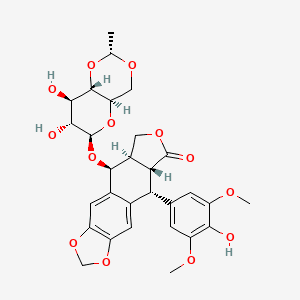
Pharmacotherapeutic group: Antineoplastic and immunomodulating agents, antineoplastic agents, plant alkaloids and other natural products, podophyllotoxin derivatives, ATC code: L01CB01
Mechanism of action
Etoposide phosphate is metabolised
in vivo
into the active substance etoposide by a process of dephosphorylation. The mechanism of action of etoposide phosphate is considered to be the same as that of etoposide.
The main effect of etoposide appears to be at the late S and early G
2
portion of the cell cycle in mammalian cells. Two dose-dependent responses are seen: At high concentrations (10 mcg/mL or more), cells entering mitosis are lysed; at low concentrations (0.3 to 10 mcg/mL), cells are inhibited from entering prophase.
Microtubule assembly is not affected. The predominant macromolecular effect of etoposide seems to be the rupture of the double strand by an interaction with DNA- topoisomerase II or by the formation of free radicals. Etoposide has been shown to cause metaphase arrest in chick fibroblasts.
⚠️ Warnings
Procedures for proper handling and disposal of anti-cancer drugs should be followed.
Care must be taken whenever handling cytostatic products. Always take steps to prevent exposure. As with other potentially toxic compounds, caution should be exercised in handling and preparing ETOPOPHOS solutions. Skin reactions associated with accidental exposure to ETOPOPHOS may occur. The use of gloves is recommended. If etoposide phosphate should contact the skin or mucosa, immediately wash the skin with soap and water and flush the mucosa with water.
ETOPOPHOS solutions must be prepared under aseptic conditions.
Preparation of ETOPOPHOS 100 mg powder for solution for infusion
Before use, the content of each vial must be reconstituted with 5 mL or 10 mL of:
• water for injections, or
• 5% glucose solution, or
• 0.9% sodium chloride solution.
This will yield a reconstituted stock solution containing 20 mg/mL or 10 mg/mL etoposide.
After reconstitution, the solution can be administered without further dilution or it can be further diluted with 5% glucose solution or 0.9% sodium chloride solution to obtain concentrations as low as 0.1 mg/mL etoposide.
The products administered by parenteral route must be visually examined to check for any particulates or discoloration prior to administration. If any discolouration or particulate matter is observed, the reconstituted solution must be discarded.
ETOPOPHOS is for single use only. Any unused medicinal product or waste material should be disposed of in accordance with local requirements.