This information is for educational purposes only. It is not intended as medical advice. Always consult a qualified healthcare professional.
Evista — Description, Dosage, Side Effects | PillsCard
Rx
Evista
60 mg, Tabletki powlekane
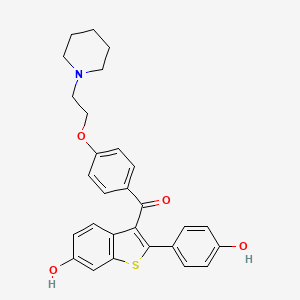
INN: Raloxifenum
Data updated: 2026-04-13
Available in:
🇨🇿🇩🇪🇬🇧🇵🇱🇵🇹🇸🇰
Form
Tabletki powlekane
Dosage
60 mg
Route
doustna
Storage
—
About This Product
User Reviews
Reviews reflect personal experiences and are not medical advice. Always consult your doctor.
Manufacturer
Substipharm (Francja)
Composition
Raloxifeni hydrochloridum 60 mg
ATC Code
G03XC01
Source
URPL
Pharmacotherapeutic group: Selective Oestrogen Receptor Modulator, ATC code: G03XC01.
Mechanism of action and Pharmacodynamic effect
As a selective oestrogen receptor modulator (SERM), raloxifene has selective agonist or antagonist activities on tissues responsive to oestrogen. It acts as an agonist on bone and partially on cholesterol metabolism (decrease in total and LDL-cholesterol), but not in the hypothalamus or in the uterine or breast tissues.
Raloxifene's biological actions, like those of oestrogen, are mediated through high affinity binding to oestrogen receptors and regulation of gene expression. This binding results in differential expression of multiple oestrogen-regulated genes in different tissues. Data suggests that the oestrogen receptor can regulate gene expression by at least two distinct pathways which are ligand-, tissue-, and/or gene-specific.
a) Skeletal effects
The decrease in oestrogen availability which occurs at menopause, leads to marked increases in bone resorption, bone loss and risk of fracture. Bone loss is particularly rapid for the first 10 years after menopause, when the compensatory increase in bone formation is inadequate to keep up with resorptive losses. Other risk factors which may lead to the development of osteoporosis include early menopause; osteopenia (at least 1 SD below peak bone mass); thin body build; Caucasian or Asian ethnic origin; and a family history of osteoporosis. Replacement therapies generally reverse the excessive resorption of bone. In postmenopausal women with osteoporosis, raloxifene reduces the incidence of vertebral fractures, preserves bone mass and increases bone mineral density (BMD).
Based on these risk factors, prevention of osteoporosis with raloxifene is indicated for women within ten years of menopause, with BMD of the spine between 1.0 and 2.5 SD below the mean value of a normal young population, taking into account their high lifetime risk for osteoporotic fractures. Likewise, raloxifene is indicated for the treatment of osteoporosis or established osteoporosis in women with BMD of the spine 2.5 SD below the mean value of a normal young population and/or with vertebral fractures, irrespective of BMD.
i) Incidence of fractures: In a study of 7,705 postmenopausal women with a mean age of 66 years and with osteoporosis or osteoporosis with an existing fracture, raloxifene treatment for 3 years reduced the incidence of vertebral fractures by 47% (RR 0.53; CI 0.35, 0.79; p <0.001) and 31% (RR 0.69; CI 0.56, 0.86; p <0.001), respectively. Forty-five women with osteoporosis or 15 women with osteoporosis with an existing fracture would need to be treated with raloxifene for 3 years to prevent one or more vertebral fractures. Raloxifene treatment for 4 years reduced the incidence of vertebral fractures by 46% (RR 0.54; CI 0.38, 0.75) and 32% (RR 0.68; CI 0.56, 0.83) in patients with osteoporosis or osteoporosis with an existing fracture, respectively. In the 4th year alone, raloxifene reduced the new vertebral fracture risk by 39% (RR 0.61; CI 0.43, 0.88). An effect on non-vertebral fractures has not been demonstrated. From the 4th to the 8th year, patients were permitted the concomitant use of bisphosphonates, calcitonin and fluorides and all patients in this study received calcium and vitamin D supplementation.
In the RUTH study, overall clinical fractures were collected as a secondary endpoint. Raloxifene reduced the incidence of clinical vertebral fractures by 35% compared with placebo (HR 0.65, CI 0.47, 0.89). These results may have been confounded by baseline differences in BMD and vertebral fractures. There was no difference between treatment groups in the incidence of new non-vertebral fractures. During the whole length of the study, concomitant use of other bone-active medications was permitted.
ii) Bone mineral density (BMD): The efficacy of raloxifene once daily in postmenopausal women aged up to 60 years and with or without a uterus was established over a two-year treatment period. The women were 2 to 8 years postmenopausal. Three trials included 1,764 postmenopausal women who were treated with raloxifene and calcium or calcium supplemented placebo. In one of these trials the women had previously undergone hysterectomy. Raloxifene produced significant increases in bone density of hip and spine as well as total body mineral mass compared to placebo. This increase was generally a 2% increase in BMD compared to placebo. A similar increase in BMD was seen in the treatment population who received raloxifene for up to 7 years. In the prevention trials, the percentage of subjects experiencing an increase or decrease in BMD during raloxifene therapy was: for the spine 37% decreased and 63% increased; and for the total hip 29% decreased and 71% increased.
iii) Calcium kinetics. Raloxifene and oestrogen affect bone remodelling and calcium metabolism similarly. Raloxifene was associated with reduced bone resorption and a mean positive shift in calcium balance of 60mg per day, due primarily to decreased urinary calcium losses.
iv) Histomorphometry (bone quality). In a study comparing raloxifene with oestrogen, bone from patients treated with either medicinal product was histologically normal, with no evidence of mineralisation defects, woven bone or marrow fibrosis.
Raloxifene decreases resorption of bone; this effect on bone is manifested as reductions in the serum and urine levels of bone turnover markers, decreases in bone resorption based on radiocalcium kinetics studies, increases in BMD and decreases in the incidence of fractures.
b) Effects on lipid metabolism and cardiovascular risk
Clinical trials showed that a 60mg daily dose of raloxifene significantly decreased total cholesterol (3 to 6%), and LDL cholesterol (4 to 10%). Women with the highest baseline cholesterol levels had the greatest decreases. HDL cholesterol and triglyceride concentrations did not change significantly. After 3 years therapy raloxifene decreased fibrinogen (6.71%). In the osteoporosis treatment study, significantly fewer raloxifene-treated patients required initiation of hypolipidaemic therapy compared to placebo.
Raloxifene therapy for 8 years did not significantly affect the risk of cardiovascular events in patients enrolled in the osteoporosis treatment study. Similarly, in the RUTH study, raloxifene did not affect the incidence of myocardial infarction, hospitalised acute coronary syndrome, stroke or overall mortality, including overall cardiovascular mortality, compared to placebo (for the increase in risk of fatal stroke, see section 4.4).
The relative risk of venous thromboembolic events observed during raloxifene treatment was 1.60 (CI 0.95, 2.71) when compared to placebo, and was 1.0 (CI 0.3, 6.2) when compared to oestrogen or hormonal replacement therapy. The risk of a thromboembolic event was greatest in the first four months of therapy.
c) Effects on the endometrium and on the pelvic floor
In clinical trials, raloxifene did not stimulate the postmenopausal uterine endometrium. Compared to placebo, raloxifene was not associated with spotting or bleeding or endometrial hyperplasia. Nearly 3,000 transvaginal ultrasound (TVUs) examinations were evaluated from 831 women in all dose groups. Raloxifene-treated women consistently had an endometrial thickness which was indistinguishable from placebo. After 3 years of treatment, at least a 5mm increase in endometrial thickness, assessed with transvaginal ultrasound, was observed in 1.9% of the 211 women treated with raloxifene 60mg/day compared to 1.8% of the 219 women who received placebo. There were no differences between the raloxifene and placebo groups with respect to the incidence of reported uterine bleeding.
Endometrial biopsies taken after six months therapy with raloxifene 60mg daily demonstrated non-proliferative endometrium in all patients. In addition, in a study with 2.5 x the recommended daily dose of raloxifene there was no evidence of endometrial proliferation and no increase in uterine volume.
In the osteoporosis treatment trial, endometrial thickness was evaluated annually in a subset of the study population (1,644 patients) for 4 years. Endometrial thickness measurements in raloxifene-treated women were not different from baseline after 4 years of therapy. There was no difference between raloxifene- and placebo-treated women in the incidences of vaginal bleeding (spotting) or vaginal discharge. Fewer raloxifene-treated women than placebo-treated women required surgical intervention for uterine prolapse. Safety information following 3 years of raloxifene treatment suggests that raloxifene treatment does not increase pelvic floor relaxation and pelvic floor surgery.
After 4 years, raloxifene did not increase the risk of endometrial or ovarian cancer. In postmenopausal women who received raloxifene treatment for 4 years, benign endometrial polyps were reported in 0.9% compared to 0.3% in women who received placebo treatment.
d) Effects on breast tissue
Raloxifene does not stimulate breast tissue. Across all placebo-controlled trials, raloxifene was indistinguishable from placebo with regard to frequency and severity of breast symptoms (no swelling, tenderness and breast pain).
Over the 4 years of the osteoporosis treatment trial (involving 7,705 patients), raloxifene treatment compared to placebo reduced the risk of total breast cancer by 62% (RR 0.38; CI 0.21, 0.69), the risk of invasive breast cancer by 71% (RR 0.29; CI 0.13, 0.58) and the risk of invasive oestrogen receptor (ER) positive breast cancer by 79% (RR 0.21; CI 0.07, 0.50). Raloxifene has no effect on the risk of ER negative breast cancers. These observations support the conclusion that raloxifene has no intrinsic oestrogen agonist activity in breast tissue.
e) Effects on cognitive function
No adverse reactions on cognitive function have been seen.