This information is for educational purposes only. It is not intended as medical advice. Always consult a qualified healthcare professional.
Farydak — Description, Dosage, Side Effects | PillsCard
Rx
Farydak
10 mg, Kapsułki twarde
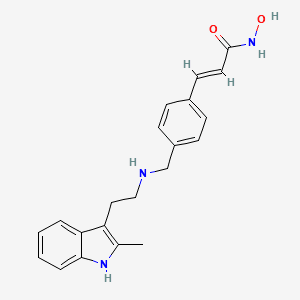
INN: Panobinostatum
Data updated: 2026-04-13
Available in:
🇨🇿🇩🇪🇬🇧🇵🇱🇸🇰
Form
Kapsułki twarde
Dosage
10 mg
Route
doustna
Storage
—
About This Product
User Reviews
Reviews reflect personal experiences and are not medical advice. Always consult your doctor.
Manufacturer
pharmaand GmbH (Hiszpania)
Composition
Panobinostatum 10 mg
ATC Code
L01XH03
Source
URPL
Pharmacotherapeutic group: Other antineoplastic agents, histone deacetylase (HDAC) inhibitors, ATC code: L01XH03
Mechanism of action
Farydak is a histone deacetylase (HDAC) inhibitor that inhibits the enzymatic activity of HDACs at nanomolar concentrations. HDACs catalyse the removal of acetyl groups from the lysine residues of histones and some non-histone proteins. Inhibition of HDAC activity results in increased acetylation of histone proteins, an epigenetic alteration that results in a relaxing of chromatin, leading to transcriptional activation.
In vitro
, panobinostat caused the accumulation of acetylated histones and other proteins, inducing cell cycle arrest and/or apoptosis of some transformed cells. Increased levels of acetylated histones were observed in xenografts from mice that were treated with panobinostat. Panobinostat shows more cytotoxicity towards tumour cells compared to normal cells.
Pharmacodynamic effects
Treatment of tumour cells with panobinostat resulted in a dose-dependent increase in acetylation of histones H3 and H4 both
in vitro
and in xenograft animal pre-clinical models, demonstrating target inhibition. In addition, increased expression of the tumour suppressor gene p21CDKNIA (cyclin dependent kinase inhibitor 1/p21) gene, a key mediator of G1 arrest and differentiation, was triggered with panobinostat exposure.
Clinical efficacy and safety
Clinical efficacy in patients with relapsed and relapsed and refractory multiple myeloma (Study D2308 – Panorama 1)
The efficacy and safety of panobinostat in combination with bortezomib and dexamethasone were evaluated in a randomised, double-blind, placebo-controlled, multicentre phase III study in patients with relapsed or relapsed and refractory multiple myeloma who had received 1-3 prior lines of therapies.
Patients received panobinostat (20 mg taken orally once a day, three times per week, on a 2 weeks on and 1 week off dosing regimen), in combination with bortezomib (1.3 mg/m
2
injected intravenously) and dexamethasone (20 mg). Treatment was administered for a maximum of 16 cycles (see Tables 1 and 2).
A total of 768 patients were randomised in a 1:1 ratio to either the panobinostat + bortezomib + dexamethasone (n=387) or the placebo + bortezomib + dexamethasone (n=381) arm, stratified by prior use of bortezomib [Yes (n=336 (43.8%)), No (n=432 (56.3%))] and number of prior lines of anti-myeloma therapy [1 prior line (n=352 (45.8%)), 2 to 3 prior lines (n=416 (54.2%))]. Demographics and baseline disease characteristics were balanced and comparable between the study arms.
The median age was 63 years, range 28-84; 42.1% of patients were older than 65 years. A total of 53.0% of patients were male. Caucasians comprised 65.0% of the study population, Asians 30.2% and blacks 2.9%. ECOG performance status was 0-1 in 93% of patients. The median number of prior therapies was 1.0. More than half (57.2%) of the patients had undergone prior stem cell transplantation and 62.8% of the patients were relapsed after previous anti-neoplastic therapies (e.g. melphalan 79.6%, dexamethasone 81.1%, thalidomide 51.2%, cyclophosphamide 45.3%, bortezomib 43.0%, combined bortezomib and dexamethasone 37.8%, lenalidomide 20.4%). More than one third (35.8%) of the patients were relapsed and refractory to prior treatment.
The median duration of follow-up was 28.75 months in the panobinostat + bortezomib + dexamethasone arm and 29.04 months in the placebo + bortezomib + dexamethasone arm.
The primary endpoint was progression free survival (PFS) as per modified European Bone Marrow Transplant Group (mEBMT) criteria and as assessed by the investigator. In the overall patient population PFS based on the full analysis set (FAS) was statistically significantly different between the treatment arms (stratified Log-rank test p<0.0001, with an estimated 37% risk reduction in the panobinostat + bortezomib + dexamethasone arm compared to the placebo + bortezomib + dexamethasone arm (Hazard ratio: 0.63 (95% CI: 0.52, 0.76)). The median PFS (95% CI) was 12.0 months (10.3, 12.9) and 8.1 months (7.6, 9.2), respectively.
Overall survival (OS) was the key secondary endpoint. OS was not statistically significantly different between the two treatment groups. The median OS was 40.3 months in the panobinostat + bortezomib + dexamethasone arm and 35.8 months in the placebo + bortezomib + dexamethasone arm (Hazard ratio: 0.94 (95% CI: 0.78, 1.14)).
Out of the pre-specified subgroup of patients with prior treatment with bortezomib and an immunomodulatory agent (N=193), 76% of patients had received at least two prior regimens. In this subset of patients (N=147), the median duration of treatment was 4.5 months in the panobinostat + bortezomib + dexamethasone arm and 4.8 months in the placebo + bortezomib + dexamethasone arm. The median PFS (95% CI) was 12.5 months (7.26, 14.03) in the panobinostat + bortezomib + dexamethasone arm and 4.7 months (3.71, 6.05) in the placebo + bortezomib + and dexamethasone arm [HR: 0.47 (0.31, 0.72)]. These patients had a median of 3 prior therapies. Efficacy results are summarised in Table 8 and the Kaplan-Meier curves for PFS are provided in Figure 2.
Table 8 Progression-free survival in patients who received at least two prior regimens including bortezomib and an immunomodulating agent
Farydak
bortezomib and dexamethasone
N=73
Placebo
bortezomib and dexamethasone
N=74
Progression-free survival
Median, months [95% CI]
12.5 [7.26, 14.03]
4.7 [3.71, 6.05]
Hazard ratio [95% CI]
1
0.47 (0.31, 0.72)
1
Hazard ratio obtained from stratified Cox model
Figure 2 Kaplan-Meier plot of progression-free survival in patients with multiple myeloma who received at least two prior regimens including bortezomib and an immunomodulatory agent
PAN= panobinostat
PBO= placebo
BTZ= bortezomib
Dex = dexamethasone
In the subgroup of patients who had received at least two prior regimens including bortezomib and an immunomodulatory agent (n=147), the overall response rate using modified EBMT criteria was 59% in the panobinostat + bortezomib + dexamethasone arm and 39% in the placebo + bortezomib + dexamethasone arm. Response rates are summarised in Table 9.
Table 9 Response rates in patients with multiple myeloma who received at least two prior regimens including bortezomib and an immunomodulatory agent
Farydak
bortezomib and dexamethasone
N=73
Placebo
bortezomib and dexamethasone
N=74
Overall response
43 (59%)
29 (39%)
[95% CI]
(46.8, 70.3)
(28, 51.2)
Complete response
6 (8%)
0
Near complete response
10 (14%)
6 (8%)
Partial response
27 (37%)
23 (31%)
Clinical efficacy in patients with bortezomib-refractory multiple myeloma (Study DUS71 – Panorama 2)
Study DUS71 was a two-stage, single-arm, open-label multicentre phase II study of oral panobinostat (20 mg) in combination with bortezomib (1.3 mg/m
2
) and dexamethasone (20 mg) in 55 patients with relapsed and refractory multiple myeloma, who were bortezomib-refractory and had received at least two prior lines of therapy. Patients had to be exposed to an IMiD (lenalidomide or thalidomide). Refractoriness to bortezomib was defined as disease progression on or within 60 days of the last bortezomib-containing line of therapy.
The primary endpoint of the study was to assess overall response rate (ORR) after 8 cycles of therapy as per mEBMT criteria.
Patients were heavily pre-treated and had received multiple prior regimens (median: 4; range: 2-11). All 55 patients were previously treated with bortezomib and at least one IMiD (lenalidomide: 98.2%, thalidomide: 69.1%). The majority of patients had received prior transplant (63.6%).
The median duration of exposure to study treatment was 4.6 months (range: 0.1-24.1 months). Patients achieved an ORR (≥PR (partial response)) of 34.5% and 52.7% (≥MR (minimal response)). The median time to response was 1.4 months and the median duration of response was 6.0 months. The median OS was 17.5 months.
Paediatric population
The European Medicines Agency has waived the obligation to submit the results of studies with Farydak in all subsets of the paediatric population in multiple myeloma (see section 4.2 for information on paediatric use).
⚠️ Warnings
Any unused medicinal product or waste material should be disposed of in accordance with local requirements.