This information is for educational purposes only. It is not intended as medical advice. Always consult a qualified healthcare professional.
Hemgenix — Description, Dosage, Side Effects | PillsCard
OTC
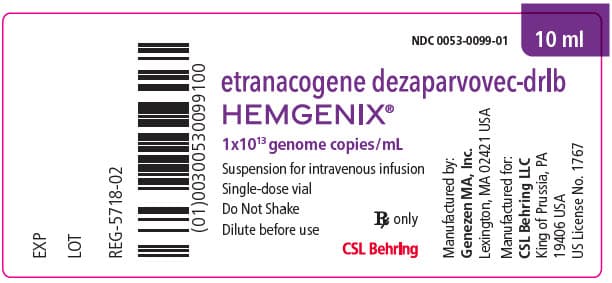
Hemgenix
1 x 10^13 kopii genomu/mL, Koncentrat do sporządzania roztworu do infuzji
INN: Etranacogenum dezaparvovecum
Data updated: 2026-04-13
Available in:
🇨🇿🇩🇪🇬🇧🇫🇷🇵🇱🇺🇦
Form
Koncentrat do sporządzania roztworu do infuzji
Dosage
1 x 10^13 kopii genomu/mL
Route
dożylna
Storage
—
About This Product
User Reviews
Reviews reflect personal experiences and are not medical advice. Always consult your doctor.
Manufacturer
CSL Behring GmbH (Niemcy)
Composition
Etranacogenum dezaparvovecum
ATC Code
B02BD16
Source
URPL
Pharmacotherapeutic group: Blood coagulation factors, ATC code: B02BD16
Mechanism of action
Etranacogene dezaparvovec is a gene therapy product designed to introduce a copy of the human Factor IX coding DNA sequence into hepatocytes to address the root cause of the Haemophilia B disease. Etranacogene dezaparvovec consists of a codon-optimised coding DNA sequence of the gain-of-function Padua variant of the human Factor IX (hFIXco-Padua), under control of the liver-specific LP1 promoter, encapsulated in a non-replicating recombinant adeno-associated viral vector of serotype 5 (AAV5) (see section 2.1).
Following single intravenous infusion, etranacogene dezaparvovec preferentially targets liver cells, where the vector DNA resides almost exclusively in episomal form (see section 5.3 below). After transduction, etranacogene dezaparvovec directs long-term liver-specific expression of Factor IX-Padua protein. As a result, etranacogene dezaparvovec partially or completely ameliorates the deficiency of circulating Factor IX procoagulant activity in patients with Haemophilia B.
Clinical efficacy and safety
The safety and efficacy of etranacogene dezaparvovec was evaluated in 2 prospective, open-label, single‑dose, single-arm studies, a phase 2b study performed in US and a phase 3 multi-national study performed in US, UK and EU. Both studies enrolled adult male patients (body weight range: 58 to 169 kg) with moderately severe or severe Haemophilia B (≤2% of Factor IX activity; N=3 in phase 2b and N=54 in phase 3), who received a single intravenous dose of 2 × 10
13
gc/kg body weight of etranacogene dezaparvovec and entered a follow-up period of 5 years.
In the pivotal phase 3 study, a total of N=54 male patients, aged 19 to 75 at enrollment (n=47 ≥18 and < 65 years; n=7 ≥ 65 years) with moderately severe or severe Haemophilia B completed a ≥6-month observational lead-in phase with standard of care routine Factor IX prophylaxis after which the patients received a single intravenous dose of etranacogene dezaparvovec. Post-treatment follow-up visits occurred regularly, with 53/54 patients completing at least 18 months of follow-up. One patient, aged 75 at screening, died of cardiogenic shock at month 15 post-dose, an event confirmed not treatment-related. The remaining 53/54 patients continue follow-up for a total of 5 years post-dose. Of these, 1 patient received a partial dose (10%) of etranacogene dezaparvovec due to an infusion reaction during infusion. All patients were on prophylactic Factor IX replacement therapy prior to dosing with etranacogene dezaparvovec. Preexisting neutralising anti-AAV5 antibodies were present in 21/54 (38.9%) patients at baseline.
The primary efficacy objective for the phase 3 study was to assess the annualised bleeding rate (ABR) reduction between month 7 and 18 post-dose, i.e., after establishment of stable Factor IX expression by month 6 post-dose, compared to the observational lead-in period. For this purpose, all bleeding episodes, regardless of investigator assessment, were considered. The efficacy results showed superiority of etranacogene dezaparvovec to continuous routine Factor IX prophylaxis (see Table 5).
Table 5. Bleeding events and Annualised Bleeding Rates
Number
≥
6-month
lead-in period
FAS (N=54)
7-18 months
post-dose
FAS (N=54)
≥
6-month
lead-in period
(N=53)
***
7-18 months
post-dose
(N=53)
***
Number of patients with bleeds
40 (74.1%)
20 (37.0%)
40 (75.5%)
19 (35.8%)
Number of patients with zero bleeds
14 (25.9%)
34 (63.0%)
13 (24.5%)
34 (64.2%)
Number of any bleeds
136
54
136
49
Number of person years for bleeding events
33.12
49.78
Adjusted
*
ABR
**
(95% CI) for any bleeds
4.19
(3.22, 5.45)
1.51
(0.81, 2.82)
3.89
(2.93, 5.16)
1.07
(0.63, 1.82)
ABR reduction (lead-in to post-treatment)
2-sided 95% Wald CI
1-sided p-value
****
-
64%
(36%, 80%)
0.0002
72%
(57%,83%)
p<0.0001
Number of patients with severe bleeds
10 (18.5%)
7 (13%)
-
-
Number of patients with very severe bleeds
3 (5.6%)
2 (3.7%)
-
-
Adjusted ABR for spontaneous bleeds
1-sided p-value
1.52
0.44
p=0.0034
-
-
Adjusted ABR for joint bleeds
1-sided p-value
2.35
0.51
p<0.0001
-
-
Adjusted ABR for traumatic bleeds
1-sided p-value
2.09
0.62
p<0.0001
-
-
Abbreviations: ABR = annualised bleeding rate; FAS = Full Analysis Set including all 54 patients dosed; CI = confidence interval
*
Adjusted ABR: Adjusted ABR rate and comparison of ABR between lead-in and post-treatment period was estimated from a statistical modelling (i.e. from a repeated measures generalised estimating equations negative binomial regression model accounting for the paired design of the study with an offset parameter to account for the differential collection periods. Treatment period was included as a categorical covariate.)
**
The ABR was measured from month 7 to month 18 after etranacogene dezaparvovec infusion, ensuring this period represented steady-state Factor IX expression from the transgene.
***
The population data includes all patients dosed except for one patient with the preexisting neutralising anti-AAV5 antibody titre of 1:3212 (tested using the clinical study assay, equivalent to 1:4417 titre based on the neutralising anti-AAV5 antibody assay with extended measuring range) who did not respond to treatment, i.e., did not show Factor IX expression and activity post-dose.
****
1-sided p-value ≤0.025 for post-treatment/lead-in <1 was regarded as statistically significant.
After single-dose of etranacogene dezaparvovec, clinically relevant increases in Factor IX activity were observed, as measured by the one-stage (aPTT-based) assay (see Table 6). Factor IX activity was also measured with chromogenic assay and the results were lower compared to the results of the one-stage (aPTT-based) assay with the mean chromogenic to one-stage Factor IX activity ratio ranging from 0.408 to 0.547 from month 6 to month 24 post-dose.
Table 6. Uncontaminated
2
Factor
IX activity at 6, 12, 18 and 24 months (FAS; one-stage (aPTT-based) assay)
Baseline
1
(N=54)
2
6 months
post-dose
(N=51)
2
12 months
post-dose
(N=50)
2
18 months
post-dose
(N=50)
2
24 months
post-dose
5
(N=50)
2
Mean % (SD)
1.19 (0.39)
38.95 (18.72)
41.48 (21.71)
36.90 (21.40)
36.66 (18.96)
Median % (min, max)
1.0
(1.0, 2.0)
37.30
(8.2, 97.1)
39.90
(5.9, 113.0)
33.55
(4.5, 122.9)
33.85
(4.7, 99.2)
Change from baseline
Least Squares (LS) mean (SE)
3
95% CI
1-sided p-value
4
n.a.
36.18 (2.432)
31.41, 40.95
p<0.0001
38.81 (2.442)
34.01, 43.60
p<0.0001
34.31 (2.444)
29.52, 39.11
p<0.0001
34.13 (2.325)
29.57, 38.69
p<0.0001
Abbreviations: aPTT = activated Partial Thromboplastin Time; CI = confidence interval; FAS = Full Analysis Set including all 54 patients dosed; LS = least squares; max = maximum; min = minimum; n.a. = not applicable; SD = standard deviation; SE = standard error.
1
Baseline: baseline Factor IX activity was imputed based on subject's historical Haemophilia B severity documented on the case report form. If the subject had documented severe Factor IX deficiency (Factor IX plasma level <1%), their baseline Factor IX activity level was imputed as 1%. If the subject had documented moderately severe Factor IX deficiency (Factor IX plasma level ≥1% and ≤2%) their baseline Factor IX activity level was imputed as 2%.
2
Uncontaminated: the blood samples collected within 5 half-lives of exogenous Factor IX use were excluded. Both the date and time of exogenous Factor IX use and blood sampling were considered in determining contamination. Patients with zero uncontaminated central laboratory post-treatment values had their change from baseline assigned to zero for this analysis, and had their post-baseline values set equal to their baseline value. Baseline Factor IX was imputed based on patients' historical Haemophilia B severity documented on the case report form. The FAS included 1 patient who received only 10% of the planned dose, 1 patient who died at month 15 post-dose due to unrelated concomitant disease, 1 patient with 1:3212 titre of preexisting neutralising anti-AAV5 antibodies (tested using the clinical study assay, equivalent to 1:4417 titre based on the neutralising anti-AAV5 antibody assay with extended measuring range) who did not respond to treatment, and 1 patient with contamination with exogenous Factor IX. Accordingly, the population data included 54 to 50 patients with uncontaminated sampling.
3
Least Squares Mean (SE): mean from repeated measures linear mixed model with visit as a categorical covariate.
4
1-sided p-value ≤0.025 for post-treatment above baseline was regarded as statistically significant.
5
For month 24, data was based on an ad-hoc analysis and the p-value was not adjusted for multiplicity.
The onset of Factor IX protein expression post-dose was detectable from the first uncontaminated measurement at week 3. In general, although more variable, Factor IX protein kinetic profile during the post-treatment period followed a trend similar to Factor IX activity.
Durability analysis of Factor IX activity showed stable Factor IX levels from 6 months up to 24 months. The durability analysis showed a similar trend of post-dose Factor IX activity for etranacogene dezaparvovec as for the predecessor, the rAAV5-hFIX gene therapy encoding wild type human Factor IX in a preceding clinical study, which showed stable post-dose Factor IX activity from 6 months up to 5 years (see section 5.3).
While overall numerically lower mean Factor IX activity was observed in patients with preexisting neutralising anti-AAV5 antibodies, no clinically meaningful correlation was identified between patients` preexisting anti-AAV5 antibody titre and their Factor IX activity at 18 months post-dose (see Table 7). In 1 patient with a titre of 1:3212 for preexisting anti-AAV5 antibodies at screening (tested using the clinical study assay, equivalent to 1:4417 titre based on the neutralising anti-AAV5 antibody assay with extended measuring range), no response to etranacogene dezaparvovec treatment was observed, with no Factor IX expression and activity.
Table 7. Endogenous Factor
IX activity levels post-dose in patients with and without preexisting neutralising anti-AAV5 antibodies (FAS; one-stage (aPTT-based) assay)
Change from Baseline
Number of patients
Mean Factor
IX activity
(%) (SD)
Median
Factor
IX activity
(%) (min, max)
Least Squares mean (SE)
†
95% CI
1-sided p‑value
With preexisting neutralising anti-AAV5 antibodies
Baseline
21
1.24 (0.44)
1.00 (1.0, 2.0)
n.a.
n.a.
n.a.
Month 6
18
35.91 (19.02)
36.60 (8.2, 90.4)
30.79 (3.827)
23.26, 38.32
<0.0001
Month 12
18
35.54 (17.84)
39.95 8.5, 73.6)
31.59 (3.847)
24.02, 39.16
<0.0001
Month 18
17
31.14 (13.75)
32.00 (10.3, 57.9)
26.83 (3.854)
19.24, 34.41
<0.0001
Month 24
17
32.98 (18.51)
33.50 (9.1, 88.3)
28.35 (3.928)
20.62, 36.08
<0.0001
Without preexisting neutralising anti-AAV5 antibodies
Baseline
33
1.15 (0.36)
1.00 (1.0, 2.0)
n.a.
n.a.
n.a.
Month 6
33
40.61 (18.64)
37.30 (8.4, 97.1)
39.46 (3.172)
33.23, 45.69
<0.0001
Month 12
32
44.82 (23.21)
38.65 (5.9, 113.0)
43.07 (3.176)
36.83, 49.31
<0.0001
Month 18
33
39.87 (24.08)
35.00 (4.5, 122.9)
38.72 (3.172)
32.49, 44.95
<0.0001
Month 24
33
38.55 (19.19)
35.40 (4.7, 99.2)
37.40 (2.933)
31.64, 43.16
<0.0001
Abbreviations: FAS = Full Analysis Set including all 54 patients dosed; aPTT = activated partial thromboplastin time; CI = confidence interval; LS = least square; max = maximum; min = minimum; n.a. = not applicable; SD = standard deviation; SE = standard error.
†
Least squares mean (SE): from repeated measures linear mixed model with visit as a categorical covariate.
The study also demonstrated superiority of etranacogene dezaparvovec at 18-months post-dose over the routine exogenous Factor IX prophylaxis in the lead-in period (see Table 8). The ABR for Factor IX-treated bleeding episodes during the month 7 to 18 post-dose period was reduced by 77% (see Table 5).
Table 8. Annualised Bleeding Rates for Factor
IX-treated bleeding episodes
≥
6-month
lead-in period
FAS (N=54)
7-18 months
post-dose
FAS (N=54)
Number of patients with Factor IX-treated bleeds
37/54 (68.5%)
15/54 (27.8%)
Number of Factor IX-treated bleeds
118
30
Adjusted ABR (95% CI) for Factor IX-treated bleeds
3.65
(2.82, 4.74)
0.84
(0.41, 1.73)
ABR ratio for Factor IX-treated bleeds (post-treatment to lead-in)
2-sided 95% Wald CI
1-sided p-value
-
0.23
(0.12, 0.46)
p<0.0001
Adjusted ABR (95% CI) for spontaneous bleeds treated with Factor IX
1.34
(0.87, 2.06)
0.45
(0.15, 1.39)
ABR ratio for spontaneous bleeds treated with Factor IX (post-treatment to lead-in)
2-sided 95% Wald CI
1-sided p-value
-
0.34
(0.11, 1.00)
p= 0.0254
Adjusted ABR (95% CI) for joint bleeds treated with Factor IX
2.13 (1.58, 2.88)
0.44 (0.19, 1.00)
ABR ratio for joint bleeds treated with Factor IX (post-treatment to lead-in)
2-sided 95% Wald CI
1-sided p-value
-
0.20
(0.09, 0.45)
p<0.0001
Abbreviations: ABR = annualised bleeding rate; FAS = Full Analysis Set including all 54 subjects dosed; CI = confidence interval
The mean consumption of Factor IX replacement therapy significantly decreased by 248,825.0 IU/year/patient (98.42%; 1-sided p< 0.0001) between month 7 and 18 and by 248.392.6 IU/year/patient (96.52%; 1-sided p< 0.0001) between month 7 to 24 following treatment with etranacogene dezaparvovec compared to standard of care routine Factor IX prophylaxis during the lead-in period. From day 21 through to months 7 to 24, 52 of 54 (96.3%) treated patients remained free of continuous routine Factor IX prophylaxis.
Overall, similar results were observed at 24 months post-dose in the phase 3 study. Of note, none of the patients showed evidence of neutralising inhibitors to etranacogene dezaparvovec-derived Factor IX over 2 years post-dose. Similarly, none of the 3 patients enrolled in the phase 2b study showed evidence of neutralising inhibitors over the period of 3 years post-dose. The 3 patients demonstrated clinically relevant increases in Factor IX activity and discontinued their routine Factor IX replacement prophylaxis over the period of 3 years post-dose.
Paediatric population
The European Medicines Agency has deferred the obligation to submit the results of studies with Hemgenix in one or more subsets of the paediatric population in the treatment of Haemophilia B (see section 4.2 for information on paediatric use).
Conditional approval
This medicinal product has been authorised under a so-called 'conditional approval' scheme. This means that further evidence on this medicinal product is awaited.
The European Medicines Agency and the Medicines and Healthcare products Regulatory Agency will review new information on this medicinal product at least every year and this SmPC will be updated as necessary.
⚠️ Warnings
Precautions to be taken before handling or administering the medicinal product
This medicinal product contains genetically modified organisms (GMOs).
Personal protective equipment, including gloves, safety goggles, protective clothing and masks, should be worn while preparing and administering etranacogene dezaparvovec.
Preparation of etranacogene dezaparvovec prior to administration
1. Use aseptic techniques during the preparation and administration of etranacogene dezaparvovec.
2. Use etranacogene dezaparvovec vial(s) only once (single-use vial(s)).
3. Verify the required dose of etranacogene dezaparvovec based on the patient's body weight. The total number of vials in each finished pack corresponds to the dosing requirement for each individual patient based on the body weight.
4. Etranacogene dezaparvovec must be diluted with sodium chloride 9 mg/mL (0.9%) solution for injection prior to administration.
- Withdraw the volume of the calculated Hemgenix dose (in mL) from the 500 mL-infusion bag(s) with sodium chloride 9 mg/mL (0.9%) solution for injection. The volume to be withdrawn will vary based on the patient body weight.
o For patients <120 kg body weight, withdraw the volume of sodium chloride 9 mg/mL (0.9%) solution for injection corresponding to the total Hemgenix dose (in mL) from one 500 mL-infusion bag.
o For patients ≥120 kg body weight, withdraw the volume of sodium chloride 9 mg/mL (0.9%) solution for injection corresponding to the total Hemgenix dose (in mL) from two 500 mL-infusion bags, by withdrawing half of the volume from each of the two 500 mL-infusion bags.
- Add subsequently the required etranacogene dezaparvovec dose to the infusion bag(s) to bring the total volume in each infusion bag back to 500 mL.
5. Add the Hemgenix dose directly into the sodium chloride 9 mg/mL (0.9%) solution for injection. Do not add the Hemgenix dose into the air in the infusion bag during diluting.
6. Gently invert the infusion bag(s) at least 3 times to mix the solution and ensure even distribution of the diluted product.
7. To avoid foaming:
- Do not shake the etranacogene dezaparvovec vial(s) and the prepared infusion bag(s).
- Do not use filter needles during preparation of etranacogene dezaparvovec.
8. To reduce the risk of spillage and/or aerosol formation, the infusion bag(s) should be provided connected to an infusion tubing prefilled with sterile sodium chloride 9 mg/mL (0.9%) solution for injection.
9. The infusion tubing prefilled with sterile sodium chloride 9 mg/mL (0.9%) solution for injection should be connected to the main intravenous infusion line also primed with sterile sodium chloride 9 mg/mL (0.9%) solution for injection prior to use.
10. Use only sodium chloride 9 mg/mL (0.9%) solution for injection since the stability of etranacogene dezaparvovec has not been determined with other solutions and diluents.
11. Do not infuse the diluted etranacogene dezaparvovec solution in the same intravenous line with any other products.
12. Do not use a central line or port.
Administration
13. Diluted etranacogene dezaparvovec should be visually inspected prior to administration. The diluted etranacogene dezaparvovec should be a clear, colourless solution. If particulates, cloudiness or discoloration are visible in the infusion bag, do not use etranacogene dezaparvovec.
14. Use the product after dilution as soon as possible. You
must not
exceed the storage time of the diluted product beyond that provided section 6.3.
15. Use an integrated (in-line) 0.2 µm filter made out of polyethersulfone (PES).
16. The diluted etranacogene dezaparvovec solution must be administered into a peripheral vein by a separate intravenous infusion line through a peripheral venous catheter.
17. Etranacogene dezaparvovec solution should be infused closely following the infusion rate(s) provided in section 4.2. The administration should be completed within ≤24 hours after the dose preparation (see section 4.2).
18. After the entire content of the infusion bag(s) is infused, the infusion line must be flushed at the same infusion rate with sodium chloride 9 mg/mL (0.9%) solution for injection to ensure all etranacogene dezaparvovec is delivered.
Measures to take in case of accidental exposure
In case of accidental exposure local guidance for pharmaceutical waste must be followed.
o In case of accidental exposure to eyes, immediately flush eyes with water for at least 15 minutes. Do not use alcohol solution.
o In case of accidental needle stick exposure, encourage bleeding of the wound and wash injection area well with soap and water.
o In case of accidental exposure to skin, the affected area must be thoroughly cleaned with soap and water for at least 15 minutes. Do not use alcohol solution.
o In case of accidental inhalation, move the person into fresh air.
o In case of accidental oral exposure, abundantly rinse mouth with water.
o In each case, obtain subsequently medical attention.
Work surfaces and materials which have potentially been in contact with etranacogene dezaparvovec must be decontaminated with appropriate disinfectant with viricidal activity (e.g. a chlorine releasing disinfectant like hypochlorite containing 0.1% available chlorine (1000 ppm)) after usage.
Precautions to be taken for the disposal of the medicinal product
Unused medicinal product and disposable materials that may have come in contact with Hemgenix (solid and liquid waste) must be disposed of in compliance with the local guidance for pharmaceutical waste.
Caregivers should be advised on the proper handling of waste material generated from contaminated medicinal ancillaries during Hemgenix use.
Work surfaces and materials which have potentially been in contact with etranacogene dezaparvovec must be decontaminated with appropriate disinfectant with viricidal activity (e.g. a chlorine releasing disinfectant like hypochlorite containing 0.1% available chlorine (1000 ppm)) after usage and then autoclaved, if possible.