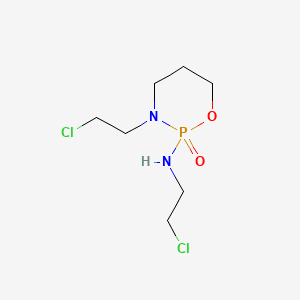
Ifosfamide is an antineoplastic, a cytotoxic alkylating agent. It is a prodrug and shows no in vitro cytotoxic activity until activated by microsomal enzymes. The cytotoxic activity of Ifosfamide (alkylation of the nucleophilic centres in the cells) is associated with the activated oxazaphosphorine ring hydroxylated at the C4 atom which interacts with DNA-DNA cross linking. This activity manifests itself by blocking the late S and early G2 phases of the cell cycle.
Paediatric population
Ewing's sarcoma
In a randomized controlled trial, 518 patients (87% under 17 years of age) with Ewing's Sarcoma, primitive neuroectodermal tumour of bone or primitive sarcoma of bone were randomized to ifosfamide/etoposide alternating with standard treatment, or to standard treatment alone. In those with no metastases at baseline, there was a statistically significant improvement in 5 year survival for those receiving ifosfamide /etoposide (69%) compared to those on standard treatment alone (54%). Overall survival at 5 years was 72% in the ifosfamide/etoposide group compared to 61% in the standard treatment group. Similar toxicities were observed in both treatment arms. In those with metastases at baseline, there was no difference in 5 year event-free survival or 5 year overall survival between treatment groups.
In a randomized comparative study of ifosfamide (VAIA regimen) and cyclophosphamide (VACA regimen) in 155 patients with standard risk Ewing'ssarcoma (83% under 19 years of age), no difference in event free survival or overall survival was demonstrated. Less toxicity was demonstrated for the ifosfamide regimen.
Other paediatric cancers
Ifosfamide has been widely investigated in uncontrolled prospective exploratory studies in children. Various dosage schedules and regimens, in combination with other antitumour agents, have been used. The following paediatric cancers have been investigated: rhabdomyosarcoma, nonrhabdomyosarcoma soft tissue sarcoma, germ cell tumours, osteosarcoma, non-Hodgkins lymphoma, Hodgkins Lymphoma , acute lymphoblastic leukaemia, neuroblastoma, Wilms tumour, and malignant CNS tumours.Favourable partial responses, complete responses and survival rates have been documented.
A variety of dosage schedules and regimens of ifosfamide in combination with other antitumor agents, are used. The prescriber should refer to chemotherapy regimens for specific tumour type in choosing a specific dosage, mode of administration and schedules. Usually the doses of ifosfamide in pediatric tumors range from 0.8 to 3 g/m
2
/day for 2-5 days for a total dose of 4-12 g/m
2
for chemotherapy course. Fractionated administration of ifosfamide is performed as intravenous infusion over a period ranging between 30 minutes and 2 hours, depending on the infusion volume or recommendations of protocol:
Uroprotection with mesna is mandatory during ifosfamide administration with a dose equivalent to 80-120 % of ifosfamide. It is recommended to prolong Mesna infusion to 12-48 hours after the end of ifosfamide infusion. 20 % of the whole Mesna dose should be given as i.v start bolus. Hyperhydration with at least 3000 ml/m
2
is required during ifosfamide infusion and for 24-48 hours after the end of ifosfamide administration.
Under treatment with ifosfamide, especially in case of long-term treatment, sufficient diuresis and regular control of renal function will be required. Children 5 years of age or younger may be more susceptible to ifosfamide-induced renal toxicity than older children or adults. Severe nephrotoxicity leading to Fanconi's syndrome has been reported. Progressive tubular damage resulting in potentially debilitating hypophosphataemia and rickets has been reported rarely but should be taken into consideration.
Paediatric data from randomized controlled clinical studies are limited.
⚠️ Warnings
Parenteral drug products should be inspected visually for particulate matter and discoloration prior to administration.
Before parenteral administration, the substance must be completely dissolved.
The following protective recommendations are advised during handling due to the toxic nature of the substance:
Reconstitution and administration must be undertaken only by trained personnel. Pregnant staff and breastfeeding mothers should be excluded.
Protective clothing, goggles, masks and disposable PVC or latex gloves should be worn.
A designated area should be defined for reconstitution (preferably under a laminar-airflow system). The work surface should be protected by a disposable, plastic backed absorbent paper. Accidental contact with the skin or eyes should be treated immediately by copious lavage with water. Soap and water should then be used on non-mucous membranes. Spillage should be removed by dry or moist disposable towels.
Care must be taken in the disposal of all waste material (syringes, needles and disposable towels etc.) Used items should be placed in appropriate secure containers in readiness for destruction in an appropriate high-temperature incinerator with an after-burner.