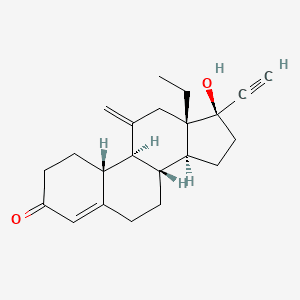
Pharmacotherapeutic group: Hormonal Contraceptives for Systemic Use, progestagens, ATC code: G03AC08
Mechanism of action
The Nexplanon implant is a non-biodegradable, radiopaque, etonogestrel-containing implant for subdermal use, preloaded in a sterile, disposable applicator. Etonogestrel is the biologically active metabolite of desogestrel, a progestagen widely used in OCs. It is structurally derived from 19-nortestosterone and binds with high affinity to progesterone receptors in the target organs. The contraceptive effect of etonogestrel is primarily achieved by inhibition of ovulation. Ovulations were not observed in the first two years of use of the implant and only rarely in the third year. Besides inhibition of ovulation, etonogestrel also causes changes in the cervical mucus, which hinders the passage of spermatozoa.
Clinical efficacy and safety
Clinical trials were conducted in women between 18 and 40 years. Although no direct comparison was made, the contraceptive efficacy appeared to be at least comparable to that known for combined OCs. During the clinical studies no pregnancies were observed during 35,057 cycles of exposure; the Pearl Index observed is 0.00 (95 % confidence limits: 0.00-0.14). However, it must be realised that in practice no method can be considered 100 % effective. The high degree of protection against pregnancy is obtained, amongst other reasons, because the contraceptive action of Nexplanon is not dependent on adherence to a dosing regimen by the woman herself. The contraceptive action of etonogestrel is reversible, which is apparent from the rapid return of the normal menstrual cycle after removal of the implant. Although etonogestrel inhibits ovulation, ovarian activity is not completely suppressed. Mean oestradiol concentrations remain above the level seen in the early-follicular phase. In a two-year study, in which the bone mineral density in 44 users has been compared to that in a control group of 29 IUD-users no adverse effects on bone mass have been observed. No clinically relevant effects on lipid metabolism have been observed. The use of progestagen-containing contraceptives may have an effect on insulin resistance and glucose tolerance. Clinical trials further indicate that users of Nexplanon often have a less painful menstrual bleeding (dysmenorrhoea).
⚠️ Warnings
See section 4.2.
The applicator is for single use only.
Any unused medicinal product or waste material should be disposed of in accordance with local requirements.