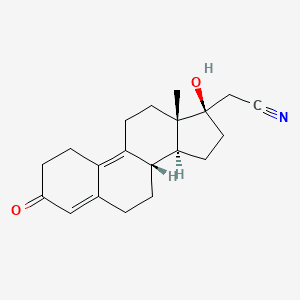
Pharmacotherapeutic group: progestogens; ATC code: G03DB08
Dienogest is a nortestosterone derivative with no androgenic but rather an antiandrogenic activity of approximately one third of that of cyproterone acetate. Dienogest binds to the progesterone receptor of the human uterus with only 10% of the relative affinity of progesterone. Despite its low affinity to the progesterone receptor, dienogest has a strong progestogenic effect in vivo. Dienogest has no significant androgenic, mineralocorticoid or glucocorticoid activity in vivo.
Dienogest acts on endometriosis by reducing the endogenous production of oestradiol and thereby suppresses the trophic effects of estradiol on both the eutopic and ectopic endometrium. When given continuously, dienogest leads to a hypoestrogenic, hypergestagenic endocrine environment causing initial decidualization of endometrial tissue followed by atrophy of endometriotic lesions.
Data on efficacy:
Superiority of dienogest over placebo was demonstrated in a 3-months study including 198 patients with endometriosis. Endometriosis-associated pelvic pain was measured on a Visual Analog Scale (0-100 mm). After 3 months of treatment with
Dienogest 2 mg a statistically significant difference compared to placebo (Δ = 12.3 mm; 95%CI: 6.4 – 18.1; p<0.0001) and a clinically meaningful reduction of pain compared to baseline (mean reduction = 27.4 mm ± 22.9) were demonstrated.
After 3 months of treatment, reduction of endometriosis-associated pelvic pain by 50% or more without relevant increase of concomitant pain medication was achieved in 37.3% of patients on Dienogest 2 mg (placebo: 19.8%); a reduction of endometriosis-associated pelvic pain by 75% or more without relevant increase of concomitant pain medication was achieved in 18.6% of patients on Dienogest 2mg (placebo: 7.3%).
The open-label extension to this placebo-controlled study suggested a continued improvement of endometriosis-associated pelvic pain for a treatment duration of up to 15 months.
The placebo controlled results were supported by the results obtained in a 6 months active- controlled study versus a GnRH agonist including 252 patients with endometriosis.
Three studies including a total of 252 patients who received a daily dose of 2 mg dienogest demonstrated a substantial reduction of endometriotic lesions after 6 months of treatment.
In a small study (n=8 per dose group), a daily dose of 1 mg dienogest has been shown to induce an anovulatory state after 1 month of treatment. Dienogest 2 mg has not been tested for contraceptive efficacy in larger studies.
Data on safety:
Endogenous estrogen levels are moderately suppressed during treatment with Dienogest 2 mg.
Currently, long-term data on bone mineral density (BMD) and risk of fractures in users of Dienogest 2 mg are not available. BMD was assessed in 21 adult patients before and after 6 months of treatment with Dienogest 2 mg and there was no reduction of mean BMD. In 29 patients treated with leuprorelin acetate (LA), a mean reduction of 4.04% ± 4.84 was noted after the same period (Δ between groups = 4.29%; 95%CI: 1.93 – 6.66; p<0.0003).
No significant changes of the mean values of standard laboratory parameters (including haematology, blood chemistry, liver enzymes, lipids and HbA1C) were observed during treatment with Dienogest 2 mg for up to 15 months (n=168).
Safety in adolescents
The safety of dienogest with respect to BMD was investigated in an uncontrolled clinical trial over 12 months in 111 adolescent women (12 to <18 years) with clinically suspected or confirmed endometriosis. The mean relative change in BMD of the lumbar spine (L2-L4) from baseline in the 103 patients with BMD measurement was -1.2 %. In a subset of the patients with decreased BMD a follow- up measurement was performed 6 months after end of treatment and showed an increase in BMD to -0.6%.
Long-term safety
A long-term post-approval observational active surveillance study was conducted to investigate the incidence of first-time occurrence or worsening of clinically relevant depression and occurrence of anemia. A total of 27,840 women with a newly prescribed hormonal therapy for endometriosis were enrolled in the study and followed up for up to 7 years.
A total of 3,023 women started with a prescription for dienogest 2 mg and 3,371 patients started with other approved endometriosis drugs. The overall adjusted hazard ratio for new occurrences of anemia comparing the dienogest patients with the patients on other approved endometriosis drugs was 1.1 (95% CI: 0.4 – 2.6). The adjusted hazard ratio for depression risk comparing dienogest and other approved endometriosis drugs was 1.8 (95% CI: 0.3-9.4). A slightly increased risk of depression in dienogest users compared with users of other approved endometriosis drugs could not be excluded.
⚠️ Warnings
No special requirements.
Any unused medicinal product or waste material should be disposed of in accordance with local requirements