This information is for educational purposes only. It is not intended as medical advice. Always consult a qualified healthcare professional.
Rx
Ondansetron
8 mg, Tabletki powlekane
INN: Ondansetronum
Data updated: 2026-04-13
Available in:
🇨🇿🇩🇪🇬🇧🇵🇱🇸🇰
Form
Tabletki powlekane
Dosage
8 mg
Route
doustna
Storage
Storage: Store at 20°C to 25°C (68°F to 77°F). [See USP Controlled Room Temperature.] Product may also be stored in a refrigerator, 2°C to 8°C (36°F to 46°F). Retain in carton until time of use. Protect from light.
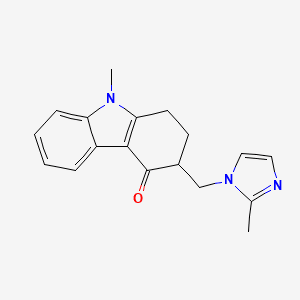
11 DESCRIPTION The active ingredient in Ondansetron Tablets, USP is ondansetron hydrochloride, USP as the dihydrate, the racemic form of ondansetron and a selective blocking agent of the serotonin 5-HT 3 receptor type. Chemically it is (±) 1, 2, 3, 9-tetrahydro-9-methyl-3-[(2-methyl-1H-imidazol-1-yl)methyl]-4H-carbazol-4-one, monohydrochloride, dihydrate. It has the following structural formula: The empirical formula is C 18 H 19 N 3 O•HCl•2H 2 O, representing a molecular weight of 365.85 g/mol. Ondansetron hydrochloride, USP (dihydrate) is a white to off-white powder that is sparingly soluble in water and in alcohol; soluble in methanol, slightly soluble in isopropyl alcohol, and in dichloromethane; very slightly soluble in acetone, in chloroform and in ethyl acetate. The active ingredient in Ondansetron Orally Disintegrating Tablets, USP is ondansetron base, the racemic form of ondansetron, and a selective blocking agent of the serotonin 5-HT 3 receptor type. Chemically it is (±) 1, 2, 3, 9-tetrahydro-9-methyl-3-[(2-methyl-1H-imidazol-1-yl)methyl]-4H-carbazol-4-one. It has the following structural formula: The empirical formula is C 18 H 19 N 3 O representing a molecular weight of 293.4 g/mol. Each 4-mg Ondansetron Tablet, USP for oral administration contains ondansetron hydrochloride, USP (dihydrate) equivalent to 4 mg of ondansetron. Each 8-mg Ondansetron Tablet, USP for oral administration contains ondansetron hydrochloride, USP (dihydrate) equivalent to 8 mg of ondansetron. Each tablet also contains the inactive ingredients colloidal silicon dioxide, hypromellose, iron oxide yellow (8 mg tablet only), lactose monohydrate, magnesium stearate, microcrystalline cellulose, pregelatinized starch, titanium dioxide and triacetin. Each 4-mg Ondansetron Orally Disintegrating Tablet, USP for oral administration contains 4 mg ondansetron base. Each 8-mg Ondansetron Orally Disintegrating Tablet, USP for oral administration contains 8 mg ondansetron base. Each Ondansetron Orally Disintegrating Tablet, USP also contains the inactive ingredients aspartame, colloidal silicon dioxide, crospovidone, magnesium stearate, mannitol, sodium stearyl fumarate and strawberry flavor. Ondansetron Orally Disintegrating Tablets, USP are an orally administered formulation of ondansetron which rapidly disintegrates on the tongue and does not require water to aid dissolution or swallowing. This product disintegrates in approximately 60 seconds. Ondansetron Orally Disintegrating Tablets, USP meet USP Disintegration Test 2. structure-hcl structure-base
⚠️ Warnings
WARNINGS Hypersensitivity reactions have been reported in patients who have exhibited hypersensitivity to other selective 5-HT 3 receptor antagonists. ECG changes including QT interval prolongation has been seen in patients receiving ondansetron. In addition, postmarketing cases of Torsade de Pointes have been reported in patients using ondansetron. Avoid ondansetron in patients with congenital long QT syndrome. ECG monitoring is recommended in patients with electrolyte abnormalities (e.g., hypokalemia or hypomagnesemia), congestive heart failure, bradyarrhythmias or patients taking other medicinal products that lead to QT prolongation. The development of serotonin syndrome has been reported with 5-HT3 receptor antagonists alone. Most reports have been associated with concomitant use of serotonergic drugs (e.g., selective serotonin reuptake inhibitors (SSRIs), serotonin and norepinephrine reuptake inhibitors (SNRIs), monoamine oxidase inhibitors, mirtazapine, fentanyl, lithium, tramadol, and intravenous methylene blue). Some of the reported cases were fatal. Serotonin syndrome occurring with overdose of ondansetron alone has also been reported. The majority of reports of serotonin syndrome related to 5-HT3 receptor antagonist use occurred in a post-anesthesia care unit or an infusion center. Symptoms associated with serotonin syndrome may include the following combination of signs and symptoms: mental status changes (e.g., agitation, hallucinations, delirium, and coma), autonomic instability (e.g., tachycardia, labile blood pressure, dizziness, diaphoresis, flushing, hyperthermia), neuromuscular symptoms (e.g., tremor, rigidity, myoclonus, hyperreflexia, incoordination), seizures, with or without gastrointestinal symptoms (e.g., nausea, vomiting, diarrhea). Patients should be monitored for the emergence of serotonin syndrome, especially with concomitant use of ondansetron and other serotonergic drugs. If symptoms of serotonin syndrome occur, discontinue ondansetron and initiate supportive treatment. Patients should be informed of the increased risk of serotonin syndrome, especially if ondansetron is used concomitantly with other serotonergic drugs (see PRECAUTIONS and OVERDOSAGE ).