Pharmacotherapeutic group: Antineoplastic and Immunomodulating agents, Immunosuppressants, Other immunosuppressants
ATC code: L04AX01
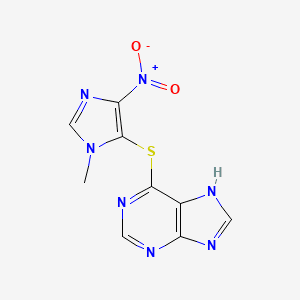
Azathioprine is an imidazole derivative of 6-mercaptopurine (6-MP). It is rapidly broken down
in vivo
into 6-MP and a methylnitroimidazole moiety. The 6-MP readily crosses cell membranes and is converted intracellularly into a number of purine thioanalogues, which include the main active nucleotide, thioinosinic acid. The rate of conversion varies from one person to another. Nucleotides do not traverse cell membranes and therefore do not circulate in body fluids. Irrespective of whether it is given directly or is derived
in vivo
from azathioprine, 6-MP is eliminated mainly as the inactive oxidised metabolite thiouric acid. This oxidation is brought about by xanthine oxidase, an enzyme that is inhibited by allopurinol. The activity of the methylnitroimidazole moiety has not been defined clearly. However, in several systems it appears to modify the activity of azathioprine as compared with that of 6-MP. Determination of plasma concentrations of azathioprine or 6-MP have no prognostic value as regards effectiveness or toxicity of these compounds.
While the precise modes of action remain to be elucidated, some suggested mechanisms include:
1.
The release of 6-MP which acts as a purine antimetabolite.
2.
The possible blockade of -SH groups by alkylation.
3.
The inhibition of many pathways in nucleic acid biosynthesis, hence preventing proliferation of cells involved in determination and amplification of the immune response.
4.
Damage to deoxyribonucleic acid (DNA) through incorporation of purine thio-analogues.
Because of these mechanisms, the therapeutic effect of azathioprine may be evident only after several weeks or months of treatment.
Azathioprine appears to be well absorbed from the upper gastro-intestinal tract.
Studies in mice with [
35
S]-azathioprine showed no unusually large concentration in any particular tissue, and there was very little [
35
S]-label found in brain.
Plasma levels of azathioprine and 6-mercaptopurine do not correlate well with the therapeutic efficacy or toxicity of azathioprine.
⚠️ Warnings
Safe handling
Health professionals who handle uncoated azathioprine tablets should follow guidelines for the handling of cytotoxic medicinal products according to prevailing local recommendations and/or regulations.
Provided that the film-coating is intact, there is no risk in handling film-coated azathioprine tablets.
Film-coated azathioprine tablets should not be divided and, provided the coating is intact, no additional precautions are required when handling them.
Disposal
Azathioprine tablets should be disposed of in a manner appropriate to the prevailing local regulatory requirements for the destruction of dangerous substances.