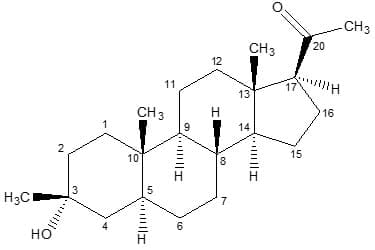
Pharmacotherapeutic group: Antiepileptics, other antiepileptics, ATC code: N03AX27.
Mechanism of action
Ganaxolone is a methyl analogue of the endogenous neurosteroid allopregnanolone. Ganaxolone is a neuroactive steroid that positively and allosterically modulates gamma-aminobutyric acid type A (GABA
A
) receptors in the CNS by interacting with a recognition site that is distinct from other allosteric GABA
A
receptor modulators.
The precise mechanism by which ganaxolone exerts its therapeutic effects in the treatment of seizures associated with CDD is unknown, but its anticonvulsant effects are thought to result from this modulation of GABA
A
receptor function providing constant, or tonic, modulation of GABA-mediated inhibitory neurotransmission.
Clinical efficacy and safety
The efficacy to treat seizures associated with CDD in patients 2 years and older was established in a single, double-blind, randomised, placebo-controlled study in patients aged 2 to 19 years (Study 1042-CDD-3001).
Patients enrolled in Study 1042-CDD-3001 had a molecular confirmation of pathogenic or likely pathogenic CDKL5 variant, their seizures were inadequately controlled by at least 2 previous concomitant AED medicinal products, and they had a minimum of 16 seizures of primary seizure type per 28 days in each 1-month period during the 2-month period prior to screening.
Totally, 101 patients were enrolled into the study (51 placebo and 50 study drug). Patients were mostly female (79.2%; consistent with the demographics of CDD) and aged between 2 and 19 years (mean [standard deviation (SD)]: 7.26 [4.55]) with the majority being paediatric (children 2 to 11 years [82.2%], adolescents [16.8%]), concomitant AEDs s were given to 96% patients. The mean (SD) number of concomitant AEDs used by subjects was 2.2 (1.14) in the placebo group and 2.6 (1.40) in the ganaxolone group. The most frequent (≥ 10 patients) concomitant AEDs were valproate, levetiracetam, clobazam and vigabatrin.
The primary efficacy endpoint was the percentage change from baseline in 28-day frequency of major motor seizures during the 17-week double blind treatment phase. Major motor seizures include bilateral tonic, bilateral clonic, atonic, generalized tonic-clonic and focal to bilateral tonic-clonic seizures. At baseline, the mean (SD) number of major motor seizures over 28-days was 104.8 (173.53) for placebo and 117.2 (138.62) for ganaxolone.
At the end of the 13-week maintenance phase, there was a statistically significant difference in the median percent change from baseline in major motor seizure frequency for patients treated with ganaxolone compared to patients receiving placebo (see table 1).
Table 1 Study 1042-CDD-3001 Change in frequency of major motor seizures per 28 days in the 13-week maintenance phase
Placebo
Ganaxolone
28-Day seizure frequency for primary seizure types, N
51
49
13-Week Maintenance, Median Percent change
(95% CI)
-6.49
(-26.77, 38.46)
-29.39
(-65.78, 1.30)
Wilcoxon Test p-value
0.0097
Response Rate, N
50
49
n (%)
6 (12.0)
15 (30.6)
Difference (95% CI)
18.6 (2.0, 34.9)
p-value
a
0.0283
CI=95% confidence interval.
a
Response is defined as at least 50% reduction from baseline in 28-day Seizure Primary Seizures Frequency. P-value is based on Fisher's Exact test.
The cumulative response curve shows that ganaxolone produced greater reductions than placebo in seizure frequency at all response rates (see figure 1).
Figure 1 Study 1042-CDD-3001 Cumulative Responder Curves of 28-Day Seizure Frequency for Primary Seizure Types – 13-Week Maintenance Phase, Intent-to-Treat Population
Open-label data
CDD patients who participated in the double-blind phase of 1042-CDD-3001 could continue the study and participate in an open-label extension phase. The primary objective of the open-label extension phase was long-term safety and tolerability of ganaxolone. To enter the open-label extension phase, patients underwent a blinded cross-titration to a maximum daily dose of 63 mg/kg/day in patients <28 kg or 1800 mg/day in patients who were at least 28 kg. Data are reported for 88 patients who participated in the open-label extension phase and received ganaxolone for up to 4.25 years. A total of 63.6% of patients discontinued study participation during the open-label extension phase, predominantly due to withdrawal by subject/parent (17.0%), lack of efficacy (18.2%) and adverse events (11.4%).
Adult population
The CDD population in Study 1042-CDD-3001 predominantly consisted of paediatric patients. Two patients were 19 years old at the time of study enrolment (one randomised to placebo, one to ganaxolone). Seven patients turned 18 years of age during the open-label extension phase of the study. For these patients (n=9), the median percent change in major motor seizure frequency from baseline to their last 3 months in the open-label phase was -32.1% (range -86.2% to 72.7%).
Paediatric population
The MHRA has deferred the obligation to submit the results of studies with ZTALMY in one or more subsets of the paediatric population in CDKL5 deficiency disorder (see section 4.2 for information on paediatric use).
⚠️ Warnings
Any unused medicinal product or waste material (including any used/unused bottle adaptors and reusable oral dosing syringes) should be disposed of in accordance with local requirements.