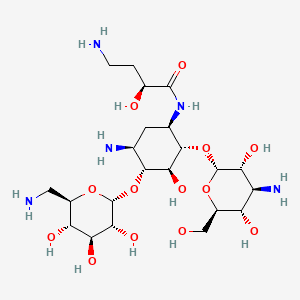
Amikacin is an aminoglycoside antibiotic whose mechanism of action involves binding to the 30S subunit of the bacterial ribosome. This results in disruption of protein synthesis essential for bacterial growth and function.
Amikacin is primarily effective against gram-negative bacterial genera and species, such as:
Pseudomonas;
Serratia;
Enterobacter;
Proteus;
Providencia;
Acinetobacter;
Klebsiella;
Escherichia coli;
Citrobacter freundii.
Amikacin also exhibits activity against gram-positive bacteria, including certain species of Streptococcus and enterococci. However, due to the availability of antibiotics with greater potency against this group of bacteria, it is rarely used for this purpose. It is, however, used against methicillin-resistant strains of Staphylococcus.
Amikacin administered topically as eye drops and during bladder irrigation is absorbed to a minimal extent. The substance is absorbed very rapidly after intramuscular administration. Peak plasma concentration is reached within one hour.
Studies have confirmed the ability of amikacin to penetrate bone tissue, lung tissue, cardiac cells, and the urinary bladder at usually administered doses. Approximately 10–11% of amikacin is bound to albumin. The administered dose exhibits bactericidal activity lasting 10 to 12 hours.
Amikacin is excreted from the body in unchanged form.
Amikacin is eliminated by the kidneys. 94–98% of the intramuscularly administered dose is excreted via glomerular filtration. The half-life in individuals with normal renal function ranges from two to three hours.
⚠️ Warnings
All antibiotics prescribed by a physician should be used for the specified duration to prevent the development of bacterial strains resistant to the active substance. Due to increasing antibiotic resistance, it is recommended that antibiotics be administered following an antibiogram (bacterial susceptibility testing), in accordance with medical advice.
The dose of amikacin depends on the patient's body weight, as well as renal function and any coexisting hearing disorders. The safety of amikacin used beyond fourteen days has not been established. If treatment exceeds 7 days, prophylactic audiogram (hearing test) is recommended.
In patients with impaired renal function, a reduction in the daily dose or extension of the interval between individual doses may be necessary to minimise the risk of hearing damage. Due to the risk of amikacin accumulation in the body, regular monitoring of plasma drug levels is recommended. Hearing damage resulting from the toxic effects of aminoglycosides is irreversible.
Caution should be exercised when administering amikacin to patients with hypersensitivity to other aminoglycosides and to individuals with cranial nerve VIII damage resulting from prior use of other ototoxic medications.
Amikacin should be used with caution in patients who have received anaesthetic agents, who have undergone significant blood transfusion (due to interaction with citrate used as an anticoagulant), or who have been administered neuromuscular blocking agents. The drug should not be used in patients with myasthenia gravis due to the risk of muscle weakness.
Due to the nephrotoxicity of amikacin, adequate patient hydration should be ensured. The risk of renal damage increases with the duration of therapy. The likelihood of renal damage is greater in elderly patients; therefore, routine creatinine clearance tests should be performed during amikacin therapy. If renal function deteriorates or red or white blood cells appear in the urine, the dose of amikacin should be adjusted.
Amikacin therapy may lead to uncontrolled overgrowth of resistant microorganisms.
Amikacin therapy in the form of eye drops requires caution when:
a hypersensitivity reaction occurs, associated with itching and eyelid inflammation;
other eye drops are used concurrently (a 15-minute interval between administrations should be observed).