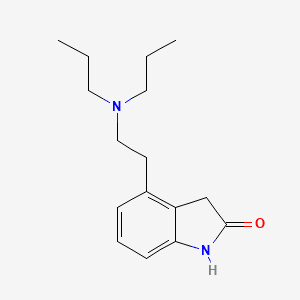
Pharmacotherapeutic group: Dopamine agonist, ATC code: N04BC04.
Mechanism of action
Ropinirole is a non-ergoline D2/D3 dopamine agonist which stimulates striatal dopamine receptors.
Clinical efficacy
ADARTREL should only be prescribed to patients with moderate to severe idiopathic Restless Legs Syndrome. Moderate to severe idiopathic Restless Legs Syndrome is typically represented by patients who suffer with insomnia or severe discomfort in the limbs.
In the four 12-week efficacy studies, patients with Restless Legs Syndrome were randomised to ropinirole or placebo, and the effects on the IRLS scale scores at week 12 were compared to baseline. The mean dose of ropinirole for the moderate to severe patients was 2.0 mg/day. In a combined analysis of moderate to severe Restless Legs Syndrome patients from the four 12-week studies, the adjusted treatment difference for the change from baseline in IRLS scale total score at week 12 Last Observation Carried Forward (LOCF) Intention To Treat population was -4.0 points (95% CI -5.6, -2.4, p < 0.0001; baseline and week 12 LOCF mean IRLS points: ropinirole 28.4 and 13.5; placebo 28.2 and 17.4).
A 12-week placebo-controlled polysomnography study in Restless Legs Syndrome patients examined the effect of treatment with ropinirole on periodic leg movements of sleep. A statistically significant difference in the periodic leg movements of sleep was seen between ropinirole and placebo from baseline to week 12.
A combined analysis of data from moderate to severe Restless Legs Syndrome patients, in the four 12-week placebo-controlled studies, indicated that ropinirole-treated patients reported significant improvements over placebo on the parameters of the Medical Outcome Study Sleep Scale (scores on 0-100 range except sleep quantity). The adjusted treatment differences between ropinirole and placebo were: sleep disturbance (-15.2, 95% CI -19.37, -10.94; p < 0.0001), sleep quantity (0.7 hours, 95% CI 0.49, 0.94); p < 0.0001), sleep adequacy (18.6, 95% CI 13.77, 23.45; p < 0.0001) and daytime somnolence (-7.5, 95% CI -10.86, -4.23; p < 0.0001).
Long term efficacy was evaluated in a randomised, double-blind, placebo-controlled clinical trial of 26 weeks. Overall results were difficult to interpret due to significant centre treatment interaction and the high proportion of missing data. No maintenance of efficacy at 26 weeks compared to placebo could be shown.
Study of the effect of ropinirole on cardiac repolarisation
A thorough QT study conducted in male and female healthy volunteers who received doses of 0.5, 1, 2 and 4 mg of ropinirole film-coated (immediate release) tablets once daily showed a maximum increase of the QT interval duration at the 1mg dose of 3.46 milliseconds (point estimate) as compared to placebo. The upper bound of the one sided 95% confidence interval for the largest mean effect was less than 7.5 milliseconds. The effect of ropinirole at higher doses has not been systematically evaluated.
The available clinical data from a thorough QT study do not indicate a risk of QT prolongation at doses of ropinirole up to 4 mg /day.
In clinical studies most patients were of Caucasian origin.