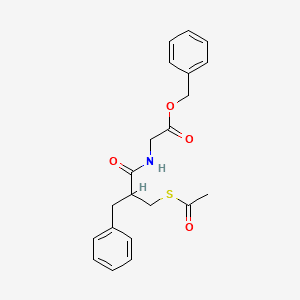
Pharmacotherapeutic group: other antidiarrheals, ATC code: A07XA04
Racecadotril is a prodrug that must be hydrolyzed to its active metabolite thiorphan. Thiorphan is an inhibitor of enkephalinase, a cell membrane peptidase found in various tissues, notably in the epithelium of the small intestine. This enzyme contributes to both the hydrolysis of exogenous peptides and the degradation of endogenous peptides, such as enkephalins. Racecadotril protects enkephalins from enzymatic degradation (which is increased in acute diarrhea), thereby prolonging their action at enkephalinergic synapses in the small intestine and reducing hypersecretion without affecting basal secretion.
Racecadotril is an active substance that exerts an antisecretory effect exclusively in the intestine. It reduces intestinal hypersecretion of water and electrolytes induced by cholera toxin or inflammation and has no effect on basal secretory activity. By potentiating the action of enkephalins at delta-opioid receptors, it produces a rapid antidiarrheal effect without modifying intestinal transit.
Racecadotril does not cause abdominal distension or increased abdominal wall tension. During clinical development, the incidence of secondary constipation in patients treated with racecadotril was comparable to that in patients receiving placebo. After oral administration, racecadotril has exclusively peripheral activity, with no effects on the central nervous system.
A randomized, crossover study showed that racecadotril 100 mg capsules administered at a therapeutic dose (1 capsule) or at a supratherapeutic dose (4 capsules) did not cause QT/QTc prolongation in 56 healthy volunteers (unlike moxifloxacin, which was used as a positive control).
In a large multinational, multicenter study conducted in patients with acute diarrhea, antisecretory racecadotril and antimotility loperamide were found to be equally effective in terms of onset of action, reduction in stool frequency, and duration of diarrhea. However, racecadotril was associated with a significantly lower incidence of constipation than loperamide and more rapidly resolved abdominal distension and pain. Assessment of signs and symptoms associated with diarrhea showed that the median duration of abdominal distension was significantly shorter with racecadotril. Furthermore, abdominal distension worsened by the end of the study in a greater proportion of patients receiving loperamide, while a greater number of patients treated with loperamide reported persistent abdominal pain at the end of the study. Adverse events during treatment occurred in a significantly smaller number of patients in the racecadotril group compared with the loperamide group.
In another randomized, double-blind study with an active comparator conducted in patients with acute diarrhea, racecadotril and loperamide were also found to be equally effective in terms of onset of action, reduction in stool frequency, and duration of diarrhea.
According to a review of clinical studies with racecadotril, the overall tolerability and safety profile of racecadotril were considered more favorable than those of loperamide.
According to a multicenter, randomized, investigator-blinded, parallel-group study, racecadotril demonstrated an equivalent safety profile and a faster onset of action as well as shorter duration of diarrhea compared with Saccharomyces boulardii in adults.
⚠️ Warnings
Precautions for use
The use of Enditril does not alter the usual rehydration regimens.
Medical advice should be sought in cases where:
diarrhea is associated with fever and/or bloody or purulent stools, as this may indicate the presence of invasive bacteria or other serious conditions;
diarrhea is associated with antibiotic use (pseudomembranous colitis).
Patients with ulcerative colitis should not treat an acute episode of diarrhea without consulting a physician.
Limited data are available in patients with renal or hepatic impairment. Special care is required and these patients should only be treated under medical supervision (see section 5.2).
Bioavailability of the active substance may be reduced in patients with persistent vomiting. In cases of chronic diarrhea, a physician should be consulted.
Hypersensitivity/angioneurotic edema has been reported in patients treated with racecadotril. These may occur at any time during treatment.
Angioedema of the face, extremities, lips, and mucous membranes may occur.
If angioedema is associated with upper airway obstruction, e.g., of the tongue, glottis, and/or larynx, emergency treatment must be initiated immediately.
Enditril must be discontinued and the patient must be placed under strict medical supervision. Appropriate monitoring must be initiated and must continue until symptoms have completely and permanently resolved.
The risk of angioedema may be increased in patients with a history of angioedema unrelated to racecadotril therapy.
Concomitant use of racecadotril and ACE inhibitors may increase the risk of angioedema (see section 4.5). Careful benefit-risk assessment is therefore required before initiating racecadotril treatment in patients taking ACE inhibitors.
Warnings
Serious cutaneous adverse reactions (SCARs):
Serious cutaneous adverse reactions (SCARs) including Stevens-Johnson syndrome, toxic epidermal necrolysis (TEN), skin exfoliation, and drug reaction with eosinophilia and systemic symptoms (DRESS), which may be life-threatening or fatal, have been reported in association with racecadotril treatment. Patients should be informed about the symptoms of these reactions and should be carefully monitored for skin reactions. If symptoms suggestive of SCARs appear (e.g., progressive skin rash, often with blister formation or mucosal lesions) or other signs of hypersensitivity, racecadotril must be discontinued immediately and alternative treatment should be considered. In severe cases, it is recommended to contact a physician immediately.
If a patient has experienced serious skin reactions while taking racecadotril, treatment with racecadotril must never be reinitiated in that patient.
Contains lactose
This medicinal product contains lactose. Patients with rare hereditary problems of galactose intolerance, total lactase deficiency, or glucose-galactose malabsorption should not take this medicinal product.