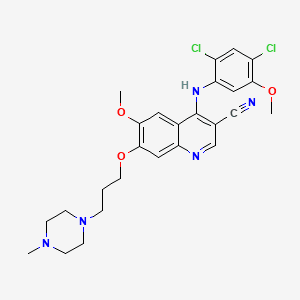
Pharmacotherapeutic group: Antineoplastic agents, protein kinase inhibitors, ATC code: L01EA04.
Mechanism of action
Bosutinib belongs to a pharmacological class of medicinal products known as kinase inhibitors. Bosutinib inhibits the abnormal BCR‑ABL kinase that promotes CML. Modelling studies indicate that bosutinib binds the kinase domain of BCR‑ABL. Bosutinib is also an inhibitor of Src family kinases including Src, Lyn and Hck. Bosutinib minimally inhibits platelet-derived growth factor (PDGF) receptor and c‑Kit.
In
in vitro
studies, bosutinib inhibits proliferation and survival of established CML cell lines, Ph+ ALL cell lines, and patient-derived primary primitive CML cells. Bosutinib inhibited 16 of 18 imatinib‑resistant forms of BCR‑ABL expressed in murine myeloid cell lines. Bosutinib treatment reduced the size of CML tumours growing in nude mice and inhibited growth of murine myeloid tumours expressing imatinib‑resistant forms of BCR‑ABL. Bosutinib also inhibits receptor tyrosine kinases c‑Fms, EphA and B receptors, Trk family kinases, Axl family kinases, Tec family kinases, some members of the ErbB family, the non‑receptor tyrosine kinase Csk, serine/threonine kinases of the Ste20 family, and 2 calmodulin‑dependent protein kinases.
Pharmacodynamic effects
The effect of bosutinib 500 mg administration on corrected QTc was evaluated in a randomised, single‑dose, double‑blind (with respect to bosutinib), crossover, placebo‑ and open‑label moxifloxacin‑controlled study in healthy subjects.
The data from this study indicate that bosutinib does not prolong the QTc in healthy subjects at the dose of 500 mg daily with food, and under conditions that give rise to supratherapeutic plasma concentrations. Following administration of a single oral dose of bosutinib 500 mg (therapeutic dose) and bosutinib 500 mg with ketoconazole 400 mg (to achieve supratherapeutic concentrations of bosutinib) in healthy subjects, the upper bound of the 1‑sided 95% confidence interval (CI) around the mean change in QTc was less than 10 ms at all post-dose time points, and no adverse events suggestive of QTc prolongation were observed.
In a study in liver impaired subjects, an increasing frequency of QTc prolongation > 450 ms with declining hepatic function was observed. In the Phase 1/2 clinical study in patients with previously treated Ph+ leukaemias treated with bosutinib 500 mg, QTcF increase > 60 ms from baseline was observed in 9 (1.6%) of 570 patients. In the Phase 3 clinical study in patients with newly‑diagnosed CP CML treated with bosutinib 400 mg, there were no patients in the bosutinib treatment group (N=268) with a QTcF increase of > 60 ms from baseline. In the Phase 3 clinical study in patients with newly-diagnosed Ph+ CP CML treated with bosutinib 500 mg, QTcF increase > 60 ms from baseline was observed in 2 (0.8%) of 248 patients receiving bosutinib. In the Phase 4 clinical study in patients with Ph+ CML previously treated with 1 or more TKI(s) treated with bosutinib 500 mg (N=163), there were no patients with a QTcF increase > 60 ms from baseline. A proarrhythmic potential of bosutinib cannot be ruled out.
Clinical efficacy
Clinical study in CP previously untreated CML in adult patients
Bosutinib 400 mg study
A 2‑arm, Phase 3, open‑label, multicentre superiority trial was conducted to investigate the efficacy and safety of bosutinib 400 mg once daily alone compared with imatinib 400 mg once daily alone in adult patients with newly‑diagnosed Ph+ CP CML. The trial randomised 536 patients (268 in each treatment group) with Ph+ or Ph‑ newly‑diagnosed CP CML (intent‑to‑treat population [ITT]) including 487 patients with Ph+ CML harbouring b2a2 and/or b3a2 transcripts and baseline BCR‑ABL copies > 0 (modified intent‑to‑treat [mITT] population).
The primary efficacy endpoint was the proportion demonstrating a major molecular response (MMR) at 12 months (48 weeks) in the bosutinib treatment group compared with that in the imatinib treatment group in the mITT population. MMR was defined as ≤ 0.1% BCR‑ABL/ABL ratio by international scale (corresponding to ≥ 3 log reduction from standardised baseline) with a minimum of 3 000 ABL transcripts as assessed by the central laboratory.
Key secondary endpoints included complete cytogenetic response (CCyR) by 12 months, duration of CCyR, duration of MMR, event‑free survival (EFS), and overall survival (OS). CCyR by Month 12, was defined as the absence of Ph+ metaphases in chromosome banding analysis of ≥ 20 metaphases derived from bone marrow aspirate or MMR if an adequate cytogenetic assessment was unavailable. The p‑values for endpoints other than MMR at 12 months and CCyR by 12 months have not been adjusted for multiple comparisons.
Baseline characteristics for the mITT population were well balanced between the 2 treatment groups with respect to age (median age was 52 years for the bosutinib group and 53 years for the imatinib group with 19.5% and 17.4% of patients 65 years of age or older, respectively); gender (women 42.3% and 44.0%, respectively); race (Caucasian 78.0% and 77.6%, Asian 12.2% and 12.4%, Black or African American 4.1% and 4.1%, and Other 5.7% and 5.4%, respectively, and 1 unknown in the imatinib group); and Sokal risk score (low risk 35.0% and 39.4%, intermediate risk 43.5% and 38.2%, high risk 21.5% and 22.4%, respectively).
After 60 months of follow-up in the mITT population, 60.2% of patients treated with bosutinib (N=246) and 59.8% of patients treated with imatinib (N=239) were still receiving first-line treatment.
After 60 months of follow‑up in the mITT population, discontinuations due to disease progression to AP or BP CML for bosutinib‑treated patients were 0.8% compared to 1.7% for imatinib‑treated patients. Six (2.4%) bosutinib patients and 7 (2.9%) imatinib patients transformed to AP CML or BP CML. Discontinuations due to suboptimal response or treatment failure as assessed by the investigator occurred for 5.3% of patients in the bosutinib‑treated group compared to 15.5% of patients in the imatinib‑treated group. Twelve (4.9%) patients on bosutinib and 14 (5.8%) patients on imatinib died while on study. No additional transformations occurred in the ITT population, there were 2 additional deaths in the bosutinib arm in the ITT population.
The efficacy results of MMR and CCyR are summarised in Table 5.
Table 5 - Summary of MMR at Months 12 and 18 and CCyR by Month 12, by treatment group in the mITT population
Response
Bosutinib
(N=246)
Imatinib
(N=241)
Odds ratio
(95% CI)
a
Major molecular response
MMR at Month 12, n (%)
(95% CI)
116 (47.2)
b
(40.9,53.4)
89 (36.9)
(30.8,43.0)
1.55 (1.07,2.23)
1-sided p-value
0.0100
b
MMR at Month 18, n (%)
(95% CI)
140 (56.9)
(50.7,63.1)
115 (47.7)
(41.4,54.0)
1.45 (1.02,2.07)
1-sided p-value
0.0208
c
Complete cytogenetic response
CCyR by Month 12, n (%)
(95% CI)
190 (77.2)
b
(72.0,82.5)
160 (66.4)
(60.4,72.4)
1.74 (1.16,2.61)
1-sided p-value
0.0037
b
Note: MMR was defined as ≤ 0.1% BCR-ABL/ABL ratio by international scale (corresponding to ≥ 3 log reduction from standardised baseline) with a minimum of 3 000 ABL transcripts assessed by the central laboratory. Complete cytogenetic response was defined as the absence of Ph+ metaphases in chromosome banding analysis of ≥ 20 metaphases derived from bone marrow aspirate or MMR if an adequate cytogenetic assessment was unavailable.
Abbreviations: BCR-ABL=breakpoint cluster region‑Abelson; CI=confidence interval; CMH=Cochran‑Mantel‑Haenszel; CCyR=complete cytogenetic response; mITT=modified intent‑to‑treat; MMR=major molecular response; N/n=number of patients; Ph+=Philadelphia chromosome-positive.
a
Adjusted for geographical region and Sokal score at randomisation.
b
Statistically significant comparison at the pre-specified significance level; based on CMH test stratified by geographical region and Sokal score at randomisation.
c
Based on CMH test stratified by geographical region and Sokal score at randomisation.
At Month 12, the MR
4
rate (defined as ≤ 0.01% BCR‑ABL [corresponding to ≥ 4 log reduction from standardised baseline] with a minimum of 9,800 ABL transcripts) was higher in the bosutinib treatment group compared to the imatinib treatment group in the mITT population (20.7% [95% CI: 15.7%, 25.8%] versus 12.0% [95% CI: 7.9%, 16.1%], respectively, odds ratio (OR) 1.88 [95% CI: 1.15, 3.08], 1‑sided p‑value=0.0052).
At Months 3, 6, and 9, the proportion of patients with MMR was higher in the bosutinib treatment group compared to the imatinib treatment group (Table 6).
Table 6 - Comparison of MMR at Months 3, 6, and 9 by treatment in the mITT population
Time
Number (%) of subjects with MMR
Odds ratio (95% CI)
a
Bosutinib
(N=246)
Imatinib
(N=241)
Month 3
(95% CI)
10 (4.1)
(1.6,6.5)
4 (1.7)
(0.0,3.3)
2.48 (0.77,7.98)
1-sided p-value
b
0.0578
Month 6
(95% CI)
86 (35.0)
(29.0,40.9)
44 (18.3)
(13.4,23.1)
2.42 (1.59,3.69)
1-sided p-value
b
< 0.0001
Month 9
(95% CI)
104 (42.3)
(36.1,48.4)
71 (29.5)
(23.7,35.2)
1.78 (1.22,2.60)
1-sided p-value
b
0.0015
Note: Percentages were based on number of patients in each treatment group. MMR was defined as ≤ 0.1% BCR‑ABL/ABL ratio on international scale (corresponding to ≥ 3 log reduction from standardised baseline) with a minimum of 3 000 ABL transcripts assessed by the central laboratory.
Abbreviations: BCR‑ABL=breakpoint cluster region‑Abelson; CI=confidence interval; CMH=Cochran‑Mantel‑Haenszel; mITT=modified intent‑to‑treat; MMR=major molecular response; N=number of patients.
a
Adjusted for geographical region and Sokal score at randomisation.
b
Based on CMH test stratified by geographical region and Sokal score at randomisation.
By Month 60 in the mITT population, the proportion of patients with MMR, MR
4
and MR
4.5
was higher in the bosutinib group compared to the imatinib group (Table 7). MMR rates by Month 60 across Sokal risk subgroups are summarised in Table 8.
Table 7 - Summary of molecular response by Month 60 in the mITT population
Response
Bosutinib
(N=246)
Imatinib
(N=241)
Odds ratio
(95% CI)
a
Molecular response by Month 60, n (%)
(95% CI)
MMR
182 (74.0)
(68.5,79.5)
158 (65.6)
(59.6,71.6)
1.52 (1.02,2.25)
MR
4
145 (58.9)
(52.8,65.1)
120 (49.8)
(43.5,56.1)
1.46 (1.02,2.09)
MR
4.5
119 (48.4)
(42.1,54.6)
93 (38.6)
(32.4,44.7)
1.50 (1.05,2.16)
Note: MMR/MR
4
/MR
4.5
were defined as ≤ 0.1/0.01/0.0032% BCR-ABL/ABL ratio on international scale (corresponding to ≥ 3/4/4.5 log reduction from standardised baseline) with a minimum of 3 000/9 800/30 990 ABL transcripts assessed by the central laboratory.
Abbreviations: BCR-ABL=breakpoint cluster region‑Abelson; CI=confidence interval; mITT=modified intent‑to‑treat; MMR=major molecular response; MR=molecular response; N/n=number of patients.
a
Adjusted for geographical region and Sokal score at randomisation.
Table 8 - Summary of MMR by Month 60 by Sokal risk score in the mITT population
Response
Bosutinib
Imatinib
Odds ratio
(95% CI)
Low Sokal risk
MMR, n (%)
(95% CI)
N=86
67 (77.9)
(69.1,86.7)
N=95
68 (71.6)
(62.5,80.6)
1.40 (0.71,2.76)
Intermediate Sokal risk
MMR, n (%)
(95% CI)
N=107
79 (73.8)
(65.5,82.2)
N=92
62 (67.4)
(57.8,77.0)
1.37 (0.74,2.52)
High Sokal risk
MMR, n (%)
(95% CI)
N=53
36 (67.9)
(55.4,80.5)
N=54
28 (51.9)
(38.5,65.2)
1.97 (0.90,4.32)
Note: Percentages were based on number of patients in each treatment group. MMR was defined as ≤ 0.1% BCR‑ABL/ABL ratio on international scale (corresponding to ≥ 3 log reduction from standardised baseline) with a minimum of 3 000 ABL transcripts assessed by the central laboratory.
Abbreviations: BCR‑ABL=breakpoint cluster region‑Abelson; CI=confidence interval; mITT=modified intent‑to‑treat; MMR=major molecular response; N/n=number of patients.
The cumulative incidence of CCyR adjusted for the competing risk of treatment discontinuation without CCyR was higher in the bosutinib treatment group compared to the imatinib treatment group in the mITT population (83.3% [95% CI: 78.1%, 87.4%] versus 76.8% [95% CI: 70.9%, 81.6%] at Month 60; hazard ratio [HR] from a stratified proportional sub distributional hazards model: 1.35, [95% CI: 1.11, 1.64]). The median time to CCyR (responders only) was 24.0 weeks (range: 11.4 to 120.7) in the bosutinib group compared to the 24.3 weeks (range: 11.4 to 96.6) in the imatinib group.
The median time to MMR, MR
4
and MR
4.5
(responders only) was 36.1 weeks (range: 11.9 to 241.9), 83.7 weeks (range: 12.4 to 244.3), and 108.0 weeks (range: 24.1 to 242.1), respectively, for the bosutinib treatment group versus 47.7 weeks (range: 12.1 to 216.1), 84.4 weeks (range: 23.6 to 241.9), and 120.4 weeks (range: 24.6 to 240.7), respectively, for the imatinib treatment group in the mITT population.
The cumulative incidence of MMR, MR
4
and MR
4.5
adjusted for the competing risk of treatment discontinuation without the event was higher with bosutinib compared to imatinib as shown in Figures 1 to 3.
Figure 1 - Cumulative incidence of MMR (mITT population)
Figure 2 - Cumulative incidence of MR
4
(mITT population)
Figure 3 - Cumulative incidence of MR
4.5
(mITT population)
In the mITT population, among patients who achieved CCyR, the Kaplan-Meier estimate of maintaining a response at Year 4 was 97.4% (95% CI: 93.9%, 98.9%) and 93.7% (95% CI: 88.9%, 96.5%) in the bosutinib and imatinib groups (HR 0.39 [95% CI: 0.14, 1.13]), respectively. Among patients who achieved MMR, the Kaplan-Meier estimate of maintaining a response at Year 4 was 92.2% (95% CI: 86.8%, 95.4%) and 92.0% (95% CI: 85.9%, 95.5%) in the bosutinib and imatinib groups (HR 1.09 [95% CI: 0.49, 2.44]), respectively.
By Month 60, 43.9% (95% CI: 37.7%, 50.1%) and 38.6% (95% CI: 32.4%, 44.7%) of bosutinib- and imatinib-treated patients (OR 1.24 [95% CI: 0.87, 1.78]) in the mITT population, respectively, had sustained MR
4
defined by the following criteria: treatment for at least 3 years with at least MR
4
at all assessments during a 1‑year period.
The cumulative incidence of on-treatment EFS events at Month 60 in the mITT population was 6.9% (95% CI: 4.2%, 10.5%) in the bosutinib arm and 10.4% (95% CI: 6.9%, 14.6%) in the imatinib arm (HR 0.64, 95% CI: 0.35, 1.17).
The Kaplan‑Meier estimates of OS at Month 60 for bosutinib and imatinib patients in the mITT population were 94.9% (95% CI: 91.1%, 97.0%) and 94.0% (95% CI: 90.1%, 96.4%), respectively (HR 0.80, 95% CI: 0.37, 1.73).
In a retrospective analysis, among evaluable patients in the ITT population, more patients in the bosutinib arm 200/248 (80.6%) achieved early molecular response (BCR-ABL transcripts ≤ 10% at 3 months) compared to patients in the imatinib arm 153/253 (60.5%), OR 2.72 (95% CI: 1.82, 4.08). MMR and EFS at Month 60 in bosutinib patients with and without early molecular response are summarised in Table 9.
Table 9 - Outcomes at Month 60 in bosutinib patients with BCR-ABL ≤ 10% vs > 10% at Month 3 in the ITT population
Bosutinib (N=248)
Patients with BCR‑ABL ≤ 10% at 3 Months
(N=200)
Patients with BCR‑ABL > 10% at 3 Months
(N=48)
Hazard Ratio
(95% CI)
a
Cumulative incidence of MMR, % (95% CI)
84.0 (78.1,88.4)
56.5 (41.1,69.4)
2.67 (1.90,3.75)
Cumulative incidence of EFS events, % (95% CI)
5.5 (2.9,9.3)
12.5 (5.1,23.4)
0.40 (0.14,1.17)
Abbreviations: BCR-ABL=breakpoint cluster region‑Abelson; CI=confidence interval; ITT=intent‑to‑treat; MMR=major molecular response; EFS=event free survival; N=number of patients with ≥ 3 000 ABL copies at Month 3.
a
Adjusted for geographical region and Sokal score at randomisation.
Fewer patients in the bosutinib arm [6 (2.4%) bosutinib and 12 (5.0%) imatinib] had newly detectable mutations at 60 months in the mITT population.
Phase 1/2 Clinical study in imatinib-resistant or intolerant CML in CP, AP, and BP
A single-arm, Phase 1/2 open-label, multicentre trial was conducted to evaluate the efficacy and safety of bosutinib 500 mg once daily in patients with imatinib‑resistant or ‑intolerant CML with separate cohorts for chronic, accelerated, and blast phase disease previously treated with 1 prior TKI (imatinib) or more than 1 TKI (imatinib followed by dasatinib and/or nilotinib).
There were 570 patients treated with bosutinib in this trial including CP CML patients previously treated with only 1 prior TKI (imatinib), CP CML patients previously treated with imatinib and at least 1 additional TKI (dasatinib and/or nilotinib), CML patients in accelerated or blast phase previously treated with at least 1 TKI (imatinib) and patients with Ph+ ALL previously treated with at least 1 TKI (imatinib).
The primary efficacy endpoint of the study was the major cytogenetic response (MCyR) rate at Week 24 in patients with imatinib‑resistant CP CML previously treated with only 1 prior TKI (imatinib). Other efficacy endpoints include the cumulative cytogenetic and molecular response rates, time to and duration of cytogenetic and molecular responses, response in baseline mutations, transformation to AP/BP, progression free survival and OS for all cohorts.
Patients who were still receiving bosutinib at the end of the Phase 1/2 study and were benefiting from bosutinib treatment as judged by the investigator, as well as those patients who had already discontinued bosutinib as part of the Phase 1/2 study and were in long-term follow-up for survival or had completed the Phase 1/2 study, were eligible for enrollment into the extension study. Each patient remained in the extension study, either on bosutinib treatment or in long‑term survival follow‑up, until the last patient reached 10 years of follow‑up, as calculated from the date of his/her first dose of bosutinib administered in the Phase 1/2 study.
Extension study efficacy endpoints included duration of cytogenetic and molecular responses, transformation to AP/BP, progression free survival, and OS.
The efficacy analyses included data from this completed extension study.
CP CML patients
The efficacy results for Ph+ CP CML patients previously treated with imatinib and at least 1 additional TKI (minimum follow-up 120 months, median treatment duration of 9 months (range: 0.23 to 164.28 months) and 20.2% and 7.6% still on-treatment at 60 and 120 months, respectively) and the results for Ph+ CP CML patients previously treated with only imatinib (minimum follow-up 120 months, median treatment duration of 26 months (range: 0.16 to 170.49 months) and 40.5% and 19.4% still on-treatment at 60 and 120 months, respectively) are presented in Table 9.
AP and BP CML patients
The efficacy results for AP (minimum follow‑up 120 months, median treatment duration of 10 months (range: 0.10 to 156.15 months) and 12.7% and 7.6% still on-treatment at 60 and 120 months, respectively) and BP (minimum follow‑up 120 months, median treatment duration of 2.8 months (range: 0.03 to 71.38 months) and 3.1% and 0% still on-treatment at 60 and 120 months, respectively) Ph+ CML patients are present in Table 10.
Table 10 - Efficacy results in previously treated patients with chronic and advanced phase CML*
Ph+ CP CML with prior imatinib treatment only
Ph+ CP CML with prior treatment with imatinib and dasatinib or nilotinib
Accelerated phase with prior treatment of at least imatinib
Blast phase with prior treatment of at least imatinib
Cumulative cytogenetic response
a
MCyR, % (95% CI)
CCyR, % (95% CI)
N=262
59.9 (53.7,65.9)
49.6 (43.4,55.8)
N=112
42.0 (32.7,51.7)
32.1 (23.6,41.6)
N=72
40.3 (28.9,52.5)
30.6 (20.2,42.5)
N=54
37.0 (24.3,51.3)
27.8 (16.5,41.6)
Cumulative molecular response
a
MMR, % (95% CI)
MR
4
, % (95% CI)
N=197
42.1 (35.1,49.4)
37.1 (30.3,44.2)
N=107
17.8 (11.0,26.3)
15.0 (8.8,23.1)
N=54
16.7 (7.9,29.3)
13.0 (5.4,24.9)
N=48
10.4 (3.5,22.7)
10.4 (3.5,22.7)
Time to MCyR for responders only
b
, median (range), weeks
12.3 (4.0,346.0)
12.3 (3.9,550.6)
12.0 (3.9,144.7)
8.2 (3.9,25.1)
Duration of MCyR
b
K‑M at year 5, % (95% CI)
K‑M at year 10, % (95% CI)
Median, weeks (95% CI)
N=157
70.7 (63.1,78.3)
65.3 (56.6,74.0)
N/R
N=47
66.6 (51.5,81.7)
55.3 (36.3,74.4)
N/R
N=29
40.8 (20.9,60.7)
40.8 (20.9,60.7)
84.0 (24.0,N/E)
N=20
21.2 (0.1,42.3)
N/E
29.1 (11.9,38.3)
Time to CCyR for responders only
b
, median (range), weeks
24.0 (7.7,240.6)
24.0 (11.6,216.0)
23.8 (4.1,120.0)
8.4 (3.9,25.1)
Duration of CCyR
b
K‑M at year 5, % (95% CI)
K‑M at year 10, % (95% CI)
Median, weeks (95% CI)
N=130
69.7 (61.3,78.2)
63.4 (54.0,72.8)
N/R
N=36
54.4 (36.7,72.1)
40.8 (22.0,59.6)
252.0 (24.0,N/E)
N=22
40.0 (18.5,61.5)
40.0 (18.5,61.5)
72.0 (36.1,N/E)
N=15
24.9 (0.9,48.9)
N/E
20.0 (9.1,29.6)
Time to MMR for responders only
b
, median (range), weeks
35.6 (3.1,367.1)
12.4 (4.0,171.7)
36.1 (12.1,144.1)
4.7 (3.9,168.9)
Duration of MMR
b
K‑M at year 5, % (95% CI)
K‑M at year 10, % (95% CI)
Median, weeks (95% CI)
N=83
74.1 (64.2,83.9)
63.4 (50.2,76.6)
N/R
N=19
70.0 (47.5,92.5)
70.0 (47.5,92.5)
N/R
N=9
66.7 (35.9,97.5)
66.7 (35.9,97.5)
N/R
N=5
60.0 (17.1,100.0)
N/E
N/R
Time to MR
4
for responders only
b
, median (range), weeks
28.0 (3.1,583.1)
23.8 (4.0,240.1)
24.1 (22.9,96.0)
4.7 (3.9,284.9)
Duration of MR
4b,e
K‑M at year 5, % (95% CI)
K‑M at year 10, % (95% CI)
Median, weeks (95% CI)
N=73
74.7 (64.2,85.2)
60.8 (46.1,75.4)
N/R
N/A
N/A
N/A
Transformation to AP/ BP
c
On-‑treatment transformation, n
N=284
15
N=119
5
N=79
3
N/A
Progression‑free survival
c
CumInc at year 5, % (95% CI)
d
CumInc at year 10, % (95% CI)
d
N=284
19.7 (15.6,24.9)
23.9 (19.5,29.5)
N=119
24.4 (17.8,33.4)
26.9 (20.0,36.2)
N=79
41.8 (32.2,54.2)
41.8 (32.2,54.2)
N=64
67.2 (56.6,79.7)
N/E
Overall survival
c
K‑M at year 5, % (95% CI)
K‑M at year 10, % (95% CI)
Median, months (95% CI)
N=284
83.5 (78.7,88.3)
71.5 (64.4,78.7)
N/R
N=119
74.1 (64.8,83.4)
60.4 (47.2,73.7)
N/R
N=79
58.5 (46.9,70.2)
50.7 (36.5,65.0)
N/R
N=64
22.5 (7.1,37.9)
22.5 (7.1,37.9)
10.9 (8.7,19.7)
Snapshot date: Phase 1/2 Study 02Oct2015, Extension Study 02Sep2020.
Cytogenetic Response criteria: MCyR included Complete [0% Ph+ metaphases from bone marrow or < 1% positive cells from fluorescent
in situ
hybridisation (FISH)] or partial (1%‑35%) cytogenetic responses. Cytogenetic responses were based on the percentage of Ph+ metaphases among ≥ 20 metaphase cells in each bone marrow sample. FISH analysis (≥ 200 cells) could be used for post-baseline cytogenetic assessments if ≥ 20 metaphases were not available. In the extension study, CCyR was imputed from MMR if a valid cytogenetic assessment was not available on a specific date.
Molecular response criteria: In the Phase 1/2 Study, MMR/MR
4
was defined as ≤ 0.1/0.01% BCR-ABL transcripts as assessed by a central laboratory (not on the international scale). In the extension study, responders had MMR/MR
4
denoted on the case report form as assessed by a local laboratory.
Abbreviations: AP=accelerated phase; BP=blast phase; Ph+=Philadelphia chromosome‑positive; CP=chronic phase; CML=chronic myelogenous leukaemia; K-M=Kaplan‑Meier; N/n=number of patients; N/A=not applicable; N/R=not reached as of minimum follow-up; N/E=not estimable; CI=confidence interval; MCyR=major cytogenetic response; CCyR=complete cytogenetic response; CumInc=cumulative incidence; MMR=major molecular response; BCR‑ABL=breakpoint cluster region-Abelson.
a
Includes patients (N) with a valid baseline assessment for cytogenetic and patients not from China, South Africa, India, or Russia for molecular as samples could not be exported for molecular assessment in those countries. The analyses allow baseline responders who maintained response post-baseline to be responders. Minimum follow-up time (time from last patient first dose to data snapshot date) of 120 months.
b
Includes patients (N) who attained or maintained response.
c
Including patients (N) who received at least 1 dose of bosutinib.
d
Cumulative incidence analysis adjusting for the competing risk of treatment discontinuation without the event.
e
Not analysed for groups with limited numbers.
The Overall Survival in the CP, AP and BP cohorts is displayed graphically in Figure 4.
Figure 4 - Kaplan-Meier Estimate of Overall Survival (OS) in CP2L, CP3L, AP, and BP
Based on the limited clinical information from the Phase 1/2 study, some evidence of clinical activity was observed in patients with BCR-ABL mutations (see Table 11).
Table 11 - Response by baseline BCR-ABL mutation status in CP CML evaluable population:
prior imatinib and dasatinib and/or nilotinib (third-line)
BCR-ABL mutation status at baseline
Incidence at baseline n (%)
a
MCyR attained or maintained Resp/Eval
b
(%)
N=112
Mutation assessed
98 (100.0)
36/92 (39.1)
No mutation
59 (60.2)
23/55 (41.8)
At least 1 mutation
39 (39.8)
13/37 (35.1)
Dasatinib resistant mutations
10 (10.2)
1/9 (11.1)
E255K/V
2 (2.0)
0/2
F317L
8 (8.2)
1/7 (14.3)
Nilotinib resistant mutations
c
13 (13.3)
8/13 (61.5)
Y253H
6 (6.1)
5/6 (83.3)
E255K/V
2 (2.0)
0/2
F359C/I/V
7 (7.1)
5/7 (71.4)
Snapshot date: Phase 1/2 Study 02Oct2015, Extension Study 02Sep2020
Note: Baseline mutations were identified before the patient's first dose of study drug.
Abbreviations: BCR‑ABL=breakpoint cluster region-Abelson; CP=chronic phase; CML=chronic myelogenous leukaemia; MCyR=major cytogenetic response; N/n=number of patients; Resp=responders; Eval=evaluable.
a
The percentage is based on number of patients with baseline mutation assessment.
b
The evaluable population includes patients who had a valid baseline disease assessment.
c
2 patients had more than 1 mutation in this category.
One patient with the E255V mutation previously treated with nilotinib achieved CHR as best response.
In vitro
testing indicated that bosutinib had limited activity against the T315I or the V299L mutation. Therefore, clinical activity in patients with these mutations is not expected.
Phase 4 Clinical study in Ph+ CML previously treated with 1 or more TKI(s)
A single‑arm, Phase 4 open‑label, non‑randomised, multi‑centre study was conducted to evaluate the efficacy and safety of bosutinib 500 mg once daily in patients with TKI‑resistant or TKI‑intolerant CML with separate cohorts for CP, AP or BP disease previously treated with 1 or more prior TKIs.
There were 163 patients treated with bosutinib in this trial including 46 patients with CP Ph+ CML and treated previously with 1 prior TKI (imatinib or dasatinib or nilotinib), 61 CP Ph+ CML patients previously treated with 2 prior TKIs (imatinib and/or dasatinib and/or nilotinib), 49 CP Ph+ CML patients treated with 3 prior TKIs (imatinib and dasatinib and nilotinib), 4 patients with AP Ph+ CML previously treated with at least 1 TKI (2 patients treated with 2 prior TKIs and 2 patients treated with 3 prior TKIs) and 3 patients with Ph- CML treated with at least 1 prior TKI.
The primary efficacy endpoint was cumulative confirmed MCyR by 1 year (Week 52) in patients with CP Ph+ CML previously treated with 1 or 2 prior TKIs and patients with CP Ph+ CML previously treated with 3 prior TKIs. For patients with AP and BP Ph+ CML with any prior TKI therapy, the primary efficacy endpoint was cumulative confirmed overall haematological response (OHR) by 1 year (Week 52). Other efficacy endpoints in Ph+ CP CML patients include cumulative cytogenetic and molecular response, the duration of cytogenetic and molecular responses, response in baseline mutations, transformation to AP/BP, PFS, and OS. Additional endpoints in the Ph+ AP/BP cohort include cumulative cytogenetic and molecular responses rates, PFS and OS.
CP CML patients
The primary endpoint of cumulative confirmed MCyR (95% CI) rate by 1 year (52 weeks) was 76.5% (66.9, 84.5) in patients treated with 1 or 2 prior TKIs and 62.2% (46.5, 76.2) in patients treated with 3 prior TKIs.
Additional efficacy results at study closure, after a minimum follow-up of 3 years, in Ph+ CP CML patients treated with 1 (median treatment duration 47.5 months (range: 0.9 to 50.1 months) and 60.9% still on‑treatment), 2 (median treatment duration 41.9 months (range: 0.4 to 48.9 months) and 45.9% still on‑treatment) and 3 (median treatment duration 20.0 months (range: 0.2 to 48.9 months) and 38.8% still on‑treatment) prior TKIs are presented in Table 12.
Table 12 – Efficacy results in previously treated patients with chronic phase Ph+ CML
Ph+ CP CML
treated with 1 prior TKI
Ph+ CP CML treated with 2 prior TKIs
Ph+ CP CML treated with 3 prior TKIs
Total Ph+ CP CML cohort
Cumulative confirmed
N=43
N=55
N=45
N=143
MCyR
a
by 1 year, % (95% CI)
83.7 (69.3,93.2)
70.9 (57.1,82.4)
62.2 (46.5,76.2)
72.0 (63.9,79.2)
Cumulative cytogenetic response
a,b
N=43
N=55
N=45
N=143
MCyR, % (95% CI)
88.4 (74.9,96.1)
85.5 (73.3,93.5)
77.8 (62.9,88.8)
83.9 (76.9,89.5)
CCyR, % (95% CI)
86.0 (72.1,94.7)
83.6 (71.2,92.2)
73.3 (58.1,85.4)
81.1 (73.7,87.2)
Cumulative molecular response
a,b
N=46
N=55
N=48
N=149
MMR, % (95% CI)
82.6 (68.6,92.2)
76.4 (63.0,86.8)
56.3 (41.2,70.5)
71.8 (63.9,78.9)
MR
4
, % (95% CI)
73.9 (58.9,85.7)
63.6 (49.6,76.2)
41.7 (27.6,56.8)
59.7 (51.4,67.7)
MR
4.5
, % (95% CI)
58.7 (43.2,73.0)
50.9 (37.1,64.6)
35.4 (22.2,50.5)
48.3 (40.1,56.6)
Time to cytogenetic response for responders only
b
, median (range), months
MCyR
3.0 (1.0,11.8)
2.9 (0.3,6.4)
3.0 (1.8,8.8)
3.0 (0.3,11.8)
CCyR
3.0 (1.0,17.6)
2.9 (0.3,6.4)
3.0 (1.8,8.8)
3.0 (0.3,17.6)
Duration of cytogenetic response
b
MCyR, K-M at year 3, % (95% CI)
96.6 (77.9,99.5)
94.4 (79.2,98.6)
96.9 (79.8,99.6)
95.6 (88.7,98.4)
CCyR, K-M at year 3, % (95% CI)
96.4 (77.2,99.5)
94.4 (79.2,98.6)
100.0 (100.0,100.0)
96.5 (89.5,98.9)
Time to molecular response for responders only, median (range), months
MMR
3.0 (2.8,23.3)
3.0 (1.0,35.9)
3.1 (1.8,9.3)
3.0 (1.0,35.9)
MR
4
6.0 (2.8,47.4)
3.1 (1.0,36.1)
3.2 (1.8,47.9)
5.5 (1.0,47.9)
MR
4.5
9.2 (2.8,47.6)
6.0 (2.8,36.2)
5.8 (1.8,18.0)
6.0 (1.8,47.6)
Duration of molecular response
b
MMR, K-M at year 3, % (95% CI)
90.7 (73.9,96.9)
81.5 (63.2,91.3)
90.2 (65.9,97.5)
87.2 (78.0,92.7)
MR
4
, K-M at year 3, % (95% CI)
89.5 (70.9,96.5)
68.7 (48.0,82.5)
85.2 (51.9,96.2)
80.7 (69.4,88.1)
Snapshot date: 23Nov2020.
Abbreviations: Ph+=Philadelphia chromosome‑positive; CP=chronic phase; CML=chronic myelogenous leukaemia; K‑M=Kaplan-Meier; N=number of patients; CI=confidence interval; MCyR=major cytogenetic response; CCyR=complete cytogenetic response; MMR=major molecular response; MR
4
=≥ 4 log‑reduction in BCR‑ABL transcripts from standardised baseline; MR
4.5
=≥ 4.5 log‑reduction in BCR‑ABL transcripts from standardised baseline.
Cumulative Confirmed MCyR criteria: Response is confirmed with 2 consecutive evaluations at least 28 days apart. To be considered a responder, the patient must have maintained a baseline response for at least 52 weeks or improved from baseline. Patients with partial cytogenetic response (PCyR) at baseline must attain CCyR on‑treatment to be counted as a cytogenetic responder. Patients with at least MMR and a deeper molecular response than baseline are counted as confirmed CCyR.
Cumulative Cytogenetic Response criteria: Major Cytogenetic Response included Complete [0% Ph+ metaphases from bone marrow or < 1% positive cells from fluorescent
in situ
hybridisation (FISH)] or partial (1%-35%) cytogenetic responses. Cytogenetic responses were based on the percentage of Ph+ metaphases among ≥ 20 metaphase cells in each bone marrow sample. FISH analysis (≥ 200 cells) could be used to assess CCyR if ≥ 20 metaphases were not available. Patients without a valid bone marrow or FISH assessment and with at least MMR are counted as CCyR.
Cumulative Molecular Response criteria: MMR, MR
4
, and MR
4.5
were defined as ≤ 0.1%, ≤ 0.01%, and ≤ 0.0032% BCR-ABL/ABL ratio on international scale, respectively (corresponding to ≥ 3, ≥ 4, and ≥ 4.5 log‑reduction from standardised baseline) with a minimum of 10 000, 10 000, and 32 000 ABL transcripts assessed by the central laboratory, respectively.
a
Includes patients (N) with a valid baseline assessment. Minimum follow-up time (time from last patient first dose to data snapshot date) of 36 months.
b
Includes patients (N) who attained or maintained response.
The cumulative incidence of MMR, MR
4
and MR
4.5
adjusted for the competing risk of treatment discontinuation without the event are shown in Figure 5.
Figure 5 - Cumulative Incidence of Molecular Response (CP Evaluable Population)
Achieved molecular responses by line of treatment are shown in Table 13.
Table 13 – Achieved molecular responses
Ph+ CP CML
treated with 1 prior TKI
Ph+ CP CML treated with 2 prior TKIs
Ph+ CP CML treated with 3 prior TKIs
Total Ph+ CP CML cohort
Patients without MMR at baseline
a
N=25
N=28
N=26
N=79
MMR, % (95% CI)
76.0 (54.9,90.6)
64.3 (44.1,81.4)
38.5 (20.2,59.4)
59.5 (47.9,70.4)
Patients without MR
4
at baseline
a
N=37
N=38
N=37
N=112
MR
4
, % (95% CI)
70.3 (53.0,84.1)
55.3 (38.3,71.4)
32.4 (18.0,49.8)
52.7 (43.0,62.2)
Patients without MR
4.5
at baseline
a
N=42
N=46
N=43
N=131
MR
4.5
, % (95% CI)
54.8 (38.7,70.2)
43.5 (28.9,58.9)
30.2 (17.2,46.1)
42.7 (34.1,51.7)
Patients with MMR at baseline
a
N=21
N=27
N=22
N=70
Deeper MR, % (95% CI)
85.7 (63.7,97.0)
66.7 (46.0,83.5)
63.6 (40.7,82.8)
71.4 (59.4,81.6)
Snapshot date: 23Nov2020.
Abbreviations: Ph+=Philadelphia chromosome‑positive; CP=chronic phase; CML=chronic myelogenous leukaemia; N=number of patients; CI=confidence interval; MMR=major molecular response; MR=molecular response; MR
4
=≥ 4 log‑reduction in BCR‑ABL transcripts from standardised baseline; MR
4.5
=≥ 4.5 log‑reduction in BCR‑ABL transcripts from standardised baseline.
a
Includes patients (N) with a valid baseline assessment. To be considered a responder, patients must have achieved an improved response from baseline. Molecular Response criteria: MMR, MR
4
, and MR
4.5
were defined as ≤ 0.1%, ≤ 0.01%, and ≤ 0.0032% BCR-ABL/ABL ratio on international scale, respectively (corresponding to ≥ 3, ≥ 4, and ≥ 4.5 log-reduction from standardised baseline) with a minimum of 10 000, 10 000, and 32 000 ABL transcripts assessed by the central laboratory, respectively.
In CP patients, there were no on-treatment progressions to AP or BP CML.
AP CML patients
In patients with Ph+ AP CML, the median duration of treatment was 22.1 months (range: 1.6 to 50.1 months), the cumulative confirmed OHR by 1 year (52 weeks) was 75.0% (95% CI: 19.4, 99.4), as was the cumulative CCyR rate, all 3 patients maintained their CCyR on-treatment.
Response by BCR-ABL Mutations at baseline
Ten patients in the CP cohort had mutations at baseline (A365V, E453K, E255K, E255V, Q252H, L298V [n=1 each], Y253F and G250E [n=2 each]). One patient in the CP cohort had a F359I mutation identified on study day 8. One patient in the AP cohort had 2 mutations (F311L and L387F) at baseline. In the CP cohort, among patients with mutations, molecular responses were observed in 4/11 (36.4%) patients, 1 patient with a E255V mutation achieved MMR and 3 patients with F359I, Y253F and A365V respectively achieved MR
4.5
. The patient with mutations in the AP cohort did not achieve any response.
Paediatric population
The efficacy of Bosulif in paediatric patients was evaluated in the BCHILD trial “A Phase I/II study of bosutinib in paediatric patients with newly-diagnosed chronic phase or resistant/intolerant Ph+ CML”.
The BCHILD trial is a Phase I/II, multicentre, international, single-arm, open-label study conducted to identify a recommended dose of bosutinib administered orally once daily in paediatric patients (aged 1 to < 18 years) with newly‑diagnosed chronic phase Ph+ CML (ND CML) or Ph+ CML who have received at least one prior TKI therapy (R/I CML) and to assess preliminary estimate the safety tolerability and efficacy, and to evaluate the Pharmacokinetics of bosutinib in this patient population.
Paediatric patients with newly-diagnosed CP Ph+ CML
The efficacy of Bosulif in paediatric patients with newly-diagnosed CP Ph+ CML (CP1L) was evaluated as part of the BCHILD trial. In the Phase II dose expansion portion 30 patients with ND CML received bosutinib at a dose of 300 mg/m
2
once daily. The median duration of follow-up for overall survival in the total cohort (N=30) was 21.91 (1.08, 45.11) months in ND CML patients, and the median treatment duration was 13.68 (0.20, 43,70). A summary of cumulative cytogenetic and molecular responses at any time in patients with ND CML is shown in Table 15. Among responders, one patient lost CCyR and MCyR.
Among evaluable ND patients (ABL copies ≥10 000), 81.08% (95% CI: 64.2, 97.7) had a BCR-ABL ratio ≤ 10% at 3 months, and 62.5% (95% CI: 38.8, 86.2) had a BCR-ABL ratio ≤ 1% at 6 months.
There were no deaths in the ND cohort and no progressions to AP or BP.
Paediatric patients with imatinib-resistant or intolerant Ph+ CP, CML
The efficacy of Bosulif in paediatric patients with resistant or intolerant Ph+ CML was evaluated as part of the BCHILD trial.
In the Phase I dose escalation portion, 28 patients with R/I CML received bosutinib at doses ranging from 300 to 400 mg/m
2
once daily. 6 patients were enrolled in the Phase II portion (400 mg/m
2
).
Table 14 – Demographic characteristics of CML patients
Phase 1
(300 mg/m
2
)
(N=6)
Phase 1
(350 mg/m
2
)
(N=11)
Phase 1
(400 mg/m
2
)
(N=11)
Phase 2 CP1L
(300 mg/m
2
)
(N=30)
Phase 2 R/I
(400 mg/m
2
)
(N=6)
Age (Years), n (%)
≥1-<6
2 (33.3)
2 (18.2)
0
2 (6.7)
0
≥6-<12
3 (50.0)
4 (36.4)
3 (27.3)
10 (33.3)
1 (16.7)
≥12-<18
1 (16.7)
5 (45.5)
8 (72.7)
18 (60.0)
5 (83.3)
Median (range)
8.50 (1, 17)
11.00 (4, 17)
15.00 (6, 17)
12.50 (5,17)
14.50 (11, 16)
Gender, n (%)
Male
5 (83.3)
4 (36.4)
7 (63.6)
18 (60.0)
4 (66.7)
Female
1 (16.7)
7 (63.6)
4 (36.4)
12 (40.0)
2 (33.3)
Race, n (%)
White
0
5 (45.5)
7 (63.6)
22 (73.3)
4 (66.7)
Black or African American
0
1 (9.1)
1 (9.1)
5 (16.7)
1 (16.7)
Asian
0
1 (9.1)
3 (27.3)
1 (3.3)
1 (16.7)
American Indian or Alaska Native
0
0
0
0
0
Native Hawaiian or Other Pacific Islander
0
0
0
2 (6.7)
0
Unknown
6 (100.0)
4 (36.4)
0
0
0
Ethnicity, n (%)
Hispanic or Latino
0
0
2 (18.2)
7 (23.3)
0
Not Hispanic or Latino
0
8 (72.7)
9 (81.8)
23 (76.7)
6 (100.0)
Unknown
6 (100.0)
3 (27.3)
0
0
0
The median duration of follow-up for overall survival in the total phase 1 portion (N=28) was 29.27 months (15.21, 85.88) and in the phase 2 portion (N=6) was 9.66 (2.00, 15.54). The median treatment duration in the phase 1 portion was 17.26 months (range 0.30 to 60.85) and 9.64 months (1.97, 15.54) in the phase 2 portion.
A summary of cumulative cytogenetic and molecular responses at any time in patients with CML is shown in Table 15. In Phase I, among responders, three patients lost CCyR and 2 patients lost MCyR. In the phase 1 portion, the probability of maintaining MMR at 18 months was 92.3% (95% CI: 56.6, 98.8).
There were no progressions to AP or BP.
Table 15 - Efficacy results in paediatric patients with resistant or intolerant Ph+ CML
Phase 1 Total
(R/I)
(N=28)
Phase 2 CP1L
(300mg/m
2
)
(N=30)
Phase 2 R/I
(400mg/m
2
)
(N=6)
Cumulative MCyR, n% (95% CI)
24 (85.7)
(67.3, 96.0)
26 (86.7)
(69.3, 96.2)
6 (100.0)
(54.1, 100.0)
Cumulative CCyR, n% (95% CI)
23 (82.1)
(63.1, 93.9)
25 (83.3)
(65.3, 94.4)
6 (100.0)
(54.1, 100.0)
Patients without MCyR at baseline, N
4
N/A
1
MCyR, n% (95% CI)
3 (75.0)
(19.4, 99.4)
N/A
1 (100.0)
(2.5, 100.0)
Patients without CCyR at baseline, N
9
N/A
2
CCyR n% (95% CI)
7 (77.8)
(40.0, 97.2)
N/A
2 (100.0)
(15.8, 100.0)
Cumulative MMR, n% (95% CI)
16 (57.1)
(37.2, 75.5)
13 (43.3)
(25.5, 62.6)
4 (66.7)
(22.3, 95.7)
Cumulative MR4, n% (95% CI)
6 (21.4)
(8.3, 41.0)
5 (16.7)
(5.6, 34.7)
1 (16.7)
(0.4, 64.1)
Cumulative MR4.5, n% (95% CI)
5 (17.9)
(6.1, 36.9)
0 (0.0)
(0.0, 11.6)
0 (0.0)
(0.0, 45.9)
Abbreviations: CCyR=complete cytogenetic response; CI=confidence interval; CML=chronic myelogenous leukaemia; CP=chronic phase; MCyR=major cytogenetic response; MMR=major molecular response; MR=molecular response; N=number of patients; n=number of events; Ph=Philadelphia chromosome-positive; R/I=resistant or intolerant.
⚠️ Warnings
Any unused medicinal product or waste material should be disposed of in accordance with local requirements.