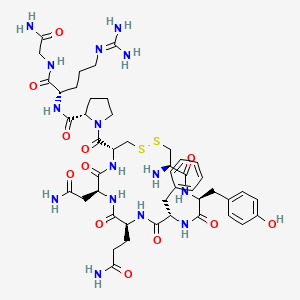
Pharmacotherapeutic group: Vasopressin and analogues, ATC code: H01BA01
Mechanism of action
Argipressin (arginine vasopressin) is an endogenous hormone with osmoregulatory, vasopressor, haemostatic, and central nervous system effects. The peripheral effects of arginine vasopressin are mediated by various vasopressin receptors, specifically the V1a, V1b, and V2 vasopressin receptors. V1a receptors have been found in arterial vessels; their activation induces vasoconstriction by increasing cytoplasmic ionised calcium through the phosphatidylinositol bisphosphate cascade, which is the most significant effect of argipressin.
During vasopressin infusion, a linear blood pressure response can be observed in patients with vasodilatory shock (septic shock, vasoplegic shock, and SIRS (systemic inflammatory response syndrome)). Specifically, a significant correlation has been demonstrated between changes in baseline-corrected mean arterial pressure (MAP) and vasopressin dose. A comparably significant linear relationship has been demonstrated between vasopressin doses and increased peripheral resistance, as well as a decrease in norepinephrine requirements.
Upon initiation of vasopressin treatment with concurrent reduction of catecholamines, a decrease in heart rate was observed in patients with septic shock. In a study in human volunteers examining the effect of vasopressin infusion after lisinopril, heart rate decreased from 67±6.5 to 62±4.5 beats per minute (P <0.05). Suppression of heart rate and cardiac index (CI) can be expected only in the dose range of 0.1 IU/min and higher.
Clinical efficacy
Clinical evidence for the efficacy of argipressin in the declared indication of hypotension in catecholamine-refractory septic shock is based on the analysis of several clinical trials and publications. A total of 1,588 patients with septic shock who had been treated with vasopressin under controlled conditions were included in this analysis.
The largest vasopressin trial in septic shock was a multicentre, randomised, double-blind clinical study (the VASST study), in which a total of 778 patients with septic shock were randomised to receive either low-dose vasopressin (0.01 to 0.03 IU/min) or norepinephrine (5 to 15 μg/min) as an adjunct to open-label vasopressors. Patients aged 16 years or older with fluid-resistant septic shock, defined as an inadequate response to 500 ml of normal saline or a need for vasopressor administration or low-dose norepinephrine, were considered for enrolment. Patients must have received ≥5 μg/min of norepinephrine or its equivalent for at least six consecutive hours during the preceding 24 hours and must have received at least 5 μg/min during the last hour before randomisation, or >15 μg/hour of norepinephrine equivalent for three consecutive hours. The primary endpoint was death from any cause, assessed 28 days after initiation of the study drug. There was no significant difference between the vasopressin (35.4%) and norepinephrine (39.3%) groups (95% confidence interval −2.9% to +10.7%, p = 0.26). Similarly, no significant difference was observed in the 90-day mortality rate (43.9% and 49.6%, respectively, p = 0.11).
In a recent double-blind randomised study (VANISH) comparing norepinephrine with early administration of argipressin (up to 0.06 IU/min), mortality in the argipressin group was 30.9% and in the norepinephrine group 27.5%. One or more serious adverse events were observed in 10.7% of patients treated with argipressin and 8.3% of patients treated with norepinephrine. Significantly fewer patients in the argipressin group required renal replacement therapy compared with the norepinephrine group (25.4% vs. 35.3%).
Effects on QT and QTc interval
Experimentally high doses of vasopressin have been shown to induce ventricular arrhythmias in animals. In the anticipated dose range and route of administration (chronic infusion), prolongation of the QT and QTc interval has not been described. Isolated cases of torsade de pointes tachycardia have been described in patients treated with vasopressin for oesophageal variceal bleeding at doses more than tenfold higher than recommended levels, but no conclusions can be drawn regarding torsadogenic potential.
Paediatric population
In a double-blind, randomised, placebo-controlled study (Choong et al., 2009), involving 69 paediatric patients with vasodilatory shock (aged 4–14 years, 54 with septic shock), 35 patients were treated with vasopressin (initial dose 0.0005 U/kg/min increased up to 0.002 U/kg/min) and 34 patients with placebo. There was no difference between vasopressin and placebo in the primary efficacy parameter (time to achieve haemodynamic stability without vasoactive therapy, 49.7 hours in the vasopressin group and 47.1 hours in the placebo group) or in secondary efficacy parameters such as ventilator-free days; 10 patients (30.3%) died in the vasopressin group, 5 (15.6%) in the placebo group. It is unclear to what extent this outcome was associated with baseline differences.
⚠️ Warnings
This medicinal product must not be confused with other medicinal products containing argipressin with a different expression of potency (for example, "Pressor Units" PU).
Argipressin must not be administered as a bolus injection in the treatment of catecholamine-refractory shock.
Argipressin may only be administered under strict and continuous monitoring of haemodynamic and organ-specific parameters.
Argipressin therapy should only be initiated if adequate perfusion pressure cannot be maintained despite sufficient volume replacement and administration of catecholaminergic vasopressors.
Argipressin should be used with particular caution in patients with cardiac or vascular disease. Administration of high doses of argipressin for other indications has been reported to cause myocardial and intestinal ischaemia, myocardial and intestinal infarction, and decreased limb perfusion.
Argipressin may in rare cases cause water intoxication. Early signs such as drowsiness, lethargy, and headache should be recognised promptly to prevent terminal coma and seizures.
Argipressin should be used with caution in epilepsy, migraine, asthma, heart failure, or any condition in which a rapid increase in extracellular water may pose a risk to an already overloaded system.
In the paediatric population, the benefits have not been shown to outweigh the risks. The use of argipressin for this indication in children and neonates is not recommended (see section 5.1).
This medicinal product contains less than 1 mmol sodium (23 mg) per ml, that is to say it is essentially "sodium-free".