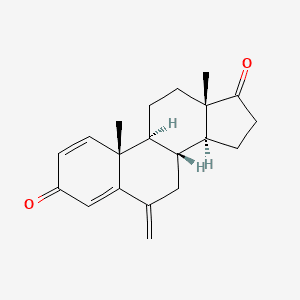
Pharmacotherapeutic group: steroidal aromatase inhibitor; anti-neoplastic agent ATC: L02BG06
Mechanism of action
Exemestane is an irreversible, steroidal aromatase inhibitor, structurally related to the natural substrate androstenedione. In post-menopausal women, oestrogens are produced primarily from the conversion of androgens into oestrogens through the aromatase enzyme in peripheral tissues. Oestrogen deprivation through aromatase inhibition is an effective and selective treatment for hormone dependent breast cancer in postmenopausal women. In postmenopausal women, Aromasin p.o. significantly lowered serum oestrogen concentrations starting from a 5 mg dose, reaching maximal suppression (>90%) with a dose of 10-25 mg. In postmenopausal breast cancer patients treated with the 25 mg daily dose, whole body aromatization was reduced by 98%.
Exemestane does not possess any progestogenic or oestrogenic activity. A slight androgenic activity, probably due to the 17-hydro derivative, has been observed mainly at high doses. In multiple daily doses trials, Aromasin had no detectable effects on adrenal biosynthesis of cortisol or aldosterone, measured before or after ACTH challenge, thus demonstrating its selectivity with regard to the other enzymes involved in the steroidogenic pathway.
Glucocorticoid or mineralocorticoid replacements are therefore not needed. A non dose-dependent slight increase in serum LH and FSH levels has been observed even at low doses: this effect is, however, expected for the pharmacological class and is probably the result of feedback at the pituitary level due to the reduction in oestrogen levels that stimulate the pituitary secretion of gonadotropins also in postmenopausal women.
Clinical efficacy and safety
Adjuvant treatment of early breast cancer
In a multicentre, randomised, double-blind study (IES), conducted in 4724 postmenopausal patients with oestrogen-receptor-positive or unknown primary breast cancer, patients who had remained disease-free after receiving adjuvant tamoxifen therapy for 2 to 3 years were randomised to receive 3 to 2 years of Aromasin (25 mg/day) or tamoxifen (20 or 30 mg/day) to complete a total of 5 years of hormonal therapy.
IES 52-month median follow-up
After a median duration of therapy of about 30 months and a median follow-up of about 52 months, results showed that sequential treatment with Aromasin after 2 to 3 years of adjuvant tamoxifen therapy was associated with a clinically and statistically significant improvement in disease-free survival (DFS) compared with continuation of tamoxifen therapy. Analysis showed that in the observed study period Aromasin reduced the risk of breast cancer recurrence by 24% compared with tamoxifen (hazard ratio 0.76; p=0.00015). The beneficial effect of exemestane over tamoxifen with respect to DFS was apparent regardless of nodal status or prior chemotherapy.
Aromasin also significantly reduced the risk of contralateral breast cancer (hazard ratio 0.57, p = 0.04158).
In the whole study population, a trend for improved overall survival was observed for exemestane (222 deaths) compared to tamoxifen (262 deaths) with a hazard ratio 0.85 (log-rank test: p = 0.07362), representing a 15% reduction in the risk of death in favour of exemestane. A statistically significant 23% reduction in the risk of dying (hazard ratio for overall survival 0.77; Wald chi square test: p = 0.0069) was observed for exemestane compared to tamoxifen when adjusting for the pre-specified prognostic factors (i.e., ER status, nodal status, prior chemotherapy, use of HRT and use of bisphosphonates).
52 month main efficacy results in all patients (intention to treat population) and oestrogen receptor positive patients
Endpoint
Population
Exemestane
Events /N (%)
Tamoxifen
Events /N (%)
Hazard Ratio
(95% CI)
p-value*
Disease-free survival
a
All patients
354
/2352 (15.1%)
453
/2372 (19.1%)
0.76 (0.67-0.88)
0.00015
ER+ patients
289
/2023 (14.3%)
370
/2021 (18.3%)
0.75 (0.65-0.88)
0.00030
Contralateral breast cancer
All patients
20
/2352 (0.9%)
35
/2372 (1.5%)
0.57 (0.33-0.99)
0.04158
ER+ patients
18
/2023 (0.9%)
33
/2021 (1.6%)
0.54 (0.30-0.95)
0.03048
Breast cancer free survival
b
All patients
289
/2352 (12.3%)
373
/2372 (15.7%)
0.76 (0.65-0.89)
0.00041
ER+ patients
232
/2023 (11.5%)
305
/2021 (15.1%)
0.73 (0.62-0.87)
0.00038
Distant recurrence free survival
c
All patients
248
/2352 (10.5%)
297
/2372 (12.5%)
0.83 (0.70-0.98)
0.02621
ER+ patients
194
/2023 (9.6%)
242
/2021 (12.0%)
0.78 (0.65-0.95)
0.01123
Overall survival
d
All patients
222
/2352 (9.4%)
262
/2372 (11.0%)
0.85 (0.71-1.02)
0.07362
ER+ patients
178
/2023 (8.8%)
211
/2021 (10.4%)
0.84 (0.68-1.02)
0.07569
* Log-rank test; ER+ patients = oestrogen receptor positive patients;
a
Disease-free survival is defined as the first occurrence of local or distant recurrence, contralateral breast cancer, or death from any cause;
b
Breast cancer free survival is defined as the first occurrence of local or distant recurrence, contralateral breast cancer or breast cancer death;
c
Distant recurrence free survival is defined as the first occurrence of distant recurrence or breast cancer death;
d
Overall survival is defined as occurrence of death from any cause.
In the additional analysis for the subset of patients with oestrogen receptor positive or unknown status, the unadjusted overall survival hazard ratio was 0.83 (log-rank test: p = 0.04250), representing a clinically and statistically significant 17% reduction in the risk of dying.
Results from the IES bone substudy demonstrated that women treated with Aromasin following 2 to 3 years of tamoxifen treatment experienced moderate reduction in bone mineral density. In the overall study, the treatment emergent fracture incidence evaluated during the 30 months treatment period was higher in patients treated with Aromasin compared with tamoxifen (4.5% and 3.3% correspondingly, p = 0.038).
Results from the IES endometrial substudy indicate that after 2 years of treatment there was a median 33% reduction of endometrial thickness in the Aromasin-treated patients compared with no notable variation in the tamoxifen-treated patients. Endometrial thickening, reported at the start of study treatment, was reversed to normal (<5 mm) for 54% of patients treated with Aromasin.
IES 87-month median follow-up
After a median duration of therapy of about 30 months and a median follow-up of about 87 months, results showed that sequential treatment with exemestane after 2 to 3 years of adjuvant tamoxifen therapy was associated with a clinically and statistically significant improvement in DFS compared with continuation of tamoxifen therapy. Results showed that in the observed study period Aromasin significantly reduced the risk of breast cancer recurrence by 16% compared with tamoxifen (hazard ratio 0.84; p = 0.002).
Overall, the beneficial effect of exemestane over tamoxifen with respect to DFS was apparent regardless of nodal status or prior chemotherapy or hormonal therapy. Statistical significance was not maintained in a few sub-groups with small sample sizes. These showed a trend favouring exemestane in patients with more than 9 nodes positive, or previous chemotherapy CMF. In patients with nodal status unknown, previous chemotherapy other, as well as unknown/missing status of previous hormonal therapy a non statistically significant trend favouring tamoxifen was observed.
In addition, exemestane also significantly prolonged breast cancer-free survival (hazard ratio 0.82, p = 0.00263), and distant recurrence-free survival (hazard ratio 0.85, p = 0.02425).
Aromasin also reduced the risk of contralateral breast cancer, although the effect was no longer statistically significant in this observed study period (hazard ratio 0.74, p = 0.12983). In the whole study population, a trend for improved overall survival was observed for exemestane (373 deaths) compared to tamoxifen (420 deaths) with a hazard ratio 0.89 (log rank test: p = 0.08972), representing an 11% reduction in the risk of death in favour of exemestane. When adjusting for the pre-specified prognostic factors (i.e., ER status, nodal status, prior chemotherapy, use of HRT and use of bisphosphonates), a statistically significant 18% reduction in the risk of dying (hazard ratio for overall survival 0.82; Wald chi square test: p = 0.0082) was observed for exemestane compared to tamoxifen in the whole study population.
In the additional analysis for the subset of patients with oestrogen receptor positive or unknown status, the unadjusted overall survival hazard ratio was 0.86 (log-rank test: p = 0.04262), representing a clinically and statistically significant 14% reduction in the risk of dying.
Results from a bone sub-study indicate that treatment with exemestane for 2 to 3 years following 3 to 2 years of tamoxifen treatment increased bone loss while on treatment (mean % change from baseline for BMD at 36 months: -3.37 [spine], -2.96 [total hip] for exemestane and -1.29 [spine], -2.02 [total hip], for tamoxifen). However, by the end of the 24 month post treatment period there were minimal differences in the change in BMD from baseline for both treatment groups, the tamoxifen arm having slightly greater final reductions in BMD at all sites (mean % change from baseline for BMD at 24 months post treatment -2.17 [spine], -3.06 [total hip] for exemestane and -3.44 [spine], -4.15 [total hip] for tamoxifen).
The all fractures reported on-treatment and during follow-up was significantly higher in the exemestane group than on tamoxifen (169 [7.3%] versus 122 [5.2%]; p = 0.004), but no difference was noted in the number of fractures reported as osteoporotic.
IES 119-month final follow-up
After a median duration of therapy of about 30 months and a median follow-up of about 119 months, results showed that sequential treatment with exemestane after 2 to 3 years of adjuvant tamoxifen therapy was associated with a clinically and statistically significant improvement in DFS compared with continuation of tamoxifen therapy. Analysis showed that over the observed study period exemestane reduced the risk of breast cancer recurrence by 14% compared with tamoxifen (hazard ratio 0.86, p = 0.00393). The beneficial effect of exemestane over tamoxifen with respect to DFS was apparent regardless of nodal status or prior chemotherapy.
Exemestane also significantly prolonged breast cancer-free survival (hazard ratio 0.83, p<0.00152) and distant recurrence-free survival (hazard ratio 0.86, p = 0.02213). Exemestane also reduced risk of contralateral breast cancer; however, the effect was no longer statistically significant (hazard ratio 0.75, p = 0.10707).
In the whole study population, overall survival was not statistically different between the two groups with 467 deaths (19.9%) occurring in the exemestane group and 510 deaths (21.5%) in the tamoxifen group (hazard ratio 0.91, p = 0.15737, not adjusted for multiple testing). For the subset of patients with oestrogen receptor positive or unknown status, the unadjusted overall survival hazard ratio was 0.89 (log-rank test: p = 0.07881) in the exemestane group relative to the tamoxifen group.
In the whole study population, a statistically significant 14% reduction in the risk of dying (hazard ratio for OS 0.86; Wald chi square test: p = 0.0257) was observed for exemestane compared with tamoxifen when adjusting for the pre-specified prognostic factors (i.e., ER status, nodal status, prior chemotherapy, use of HRT and use of bisphosphonates).
A lower incidence of other second (non-breast) primary cancers was observed in exemestane treated patients compared with tamoxifen only-treated patients (9.9% versus 12.4%).
In the main study, which had a median follow-up in all participants of 119 months (0 – 163.94) and median duration of exemestane treatment of 30 months (0 – 40.41), the incidence of bone fractures was reported on 169 (7.3%) patients in the exemestane group compared with 122 (5.2%) patients in the tamoxifen group (p=0.004).
Efficacy Results From IES in Postmenopausal Women With Early Breast Cancer (ITT)
No. of Events
Hazard Ratio
Exemestane
Tamoxifen
Hazard Ratio
p-value
30-Month Median Treatment and 34.5-Month Median Follow-Up
Disease-free survival
a
213
306
0.69 (95% CI: 0.58-0.82)
0.00003
Breast cancer-free survival
b
171
262
0.65 (95% CI: 0.54-0.79)
<0.00001
Contralateral breast cancer
8
25
0.32 (95% CI: 0.15-0.72)
0.00340
Distant recurrence-free survival
c
142
204
0.70 (95% CI: 0.56-0.86)
0.00083
Overall survival
d
116
137
0.86 (95% CI: 0.67-1.10)
0.22962
30-Month Median Treatment and 52-Month Median Follow-Up
Disease-free survival
a
354
453
0.77 (95% CI: 0.67-0.88)
0.00015
Breast cancer-free survival
b
289
373
0.76 (95% CI: 0.65-0.89)
0.00041
Contralateral breast cancer
20
35
0.57 (95% CI: 0.33-0.99)
0.04158
Distant recurrence-free survival
c
248
297
0.83 (95% CI: 0.70-0.98)
0.02621
Overall survival
d
222
262
0.85 (95% CI: 0.71-1.02)
0.07362
30-Month Median Treatment and 87-Month Median Follow-Up
Disease-free survival
a
552
641
0.84 (95% CI: 0.75-0.94)
0.002
Breast cancer-free survival
b
434
513
0.82 (95% CI: 0.72-0.94)
0.00263
Contralateral breast cancer
43
58
0.74 (95% CI: 0.50-1.10)
0.12983
Distant recurrence-free survival
c
353
409
0.85 ((95% CI: 0.74-0.98)
0.02425
Overall survival
d
373
420
0.89 (95% CI: 0.77-1.02)
0.08972
30-Month Median Treatment and 119-Month Median Follow-Up
Disease-free survival
a
672
761
0.86 (95% CI: 0.77-0.95)
0.00393
Breast cancer-free survival
b
517
608
0.83 (95% CI: 0.74-0.93)
0.00152
Contralateral breast cancer
57
75
0.75 (95% CI: 0.53-1.06)
0.10707
Distant recurrence-free survival
c
411
472
0.86 (95% CI: 0.75-0.98)
0.02213
Overall survival
d
467
510
0.91 (95% CI: 0.81-1.04)
0.15737
CI = confidence interval; IES = Intergroup Exemestane Study; ITT = intention-to-treat.
a. Disease-free survival is defined as the first occurrence of local or distant recurrence, contralateral breast cancer or death from any cause.
b. Breast cancer-free survival is defined as the first occurrence of local or distant recurrence, contralateral breast cancer or breast cancer death.
c. Distant recurrence-free survival is defined as the first occurrence of distant recurrence or breast cancer death.
d. Overall survival is defined as occurrence of death from any cause.
Treatment of advanced breast cancer
In a randomised peer reviewed controlled clinical trial, Aromasin at the daily dose of 25 mg has demonstrated statistically significant prolongation of survival, Time to Progression (TTP), Time to Treatment Failure (TTF) as compared to a standard hormonal treatment with megestrol acetate in postmenopausal patients with advanced breast cancer that had progressed following, or during, treatment with tamoxifen either as adjuvant therapy or as first-line treatment for advanced disease.