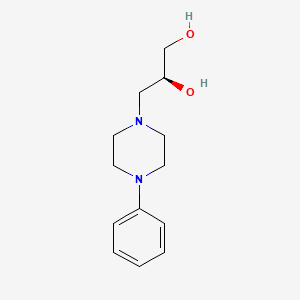
From a pharmacological standpoint, this substance is rightly defined as a peripheral cough suppressant, since its fundamental difference from traditional codeine-type cough suppressants, which are also synthetic, is that instead of acting on the cough centre, it exerts its action at the level of the peripheral receptors of the tracheobronchial mucosa.
This fact is particularly advantageous for its use in paediatrics compared to central cough suppressants, which are generally accompanied by an emetic action.
It interrupts the cough reflex at its origin, namely at the point where irritative stimulation of the tracheobronchial mucosa occurs, precisely at the level of the peripheral receptors.
The tussigenic stimulus, whether bacterial infectious, irritative, toxic, or manifesting through a physicochemical mechanism, is thereby blocked at its origin, and the reflex arc — peripheral receptor – afferent pathways – medullary cough centre – efferent pathways – respiratory tract musculature — is interrupted in the most logical and appropriate manner at the periphery.
It has been demonstrated that this peripheral antitussive action is not attributable to a purely anaesthetic or sedative effect.
The antitussive effect has been evaluated through numerous pharmacological studies.
One of these, carried out in the anaesthetised cat, used the Domenjoz method, which consists of electrical stimulation of the superior laryngeal nerve.
The results demonstrated that dropropizine is active at a dose of 25–30 mg/kg intravenously and 34 mg/kg orally.
Other studies used the Schroeder method, in which coughing is induced by electrical stimulation of the vagus nerve in the dog.
Dropropizine showed an antitussive effect at a dose of 17 mg/kg.
In another study, coughing was induced peripherally in the guinea pig and the rat by inhalation of a citric acid aerosol.
It was demonstrated that dropropizine exerts its protective action against this irritant solution at a dose of 20 mg/kg I.V. in the guinea pig and 160 mg/kg orally in the rat; these doses are very close to those obtained with codeine.
Pharmacological studies also revealed that dropropizine does not potentiate the effect of barbiturates, from which it is concluded that the cough-suppressing action of dropropizine does not arise from a narcotic effect and therefore does not interfere with the animal's behaviour.
It was also demonstrated that it does not increase bronchial tone nor exert a bronchoconstrictor action, which is sometimes observed with codeine at certain doses.
It was also found that dropropizine may exert a slight antihistaminic action.
At doses considerably higher than those recommended for the antitussive effect, it was observed that dropropizine may also exert a slight central analgesic effect similar to that of codeine.
Studies on the cardiovascular system conducted in various experimental animals revealed a slight hypotensive and adrenolytic action of dropropizine, both intravenously and orally, which disappears, however, 24 hours after discontinuation of treatment, and which occurs only at high doses exceeding those recommended for the cough-suppressing effect.
⚠️ Warnings
Pregnancy
Pregnancy:
As a precautionary measure, it is recommended that dropropizine not be used during pregnancy, especially during the first three months.
Breastfeeding
Breastfeeding:
As a precautionary measure, it is recommended that dropropizine not be used during breastfeeding unless expressly indicated by a physician.
Driving
Driving:
At the usual dosage, no effects of the medicinal product are known that could impair the ability to drive vehicles or operate machinery.
None known.