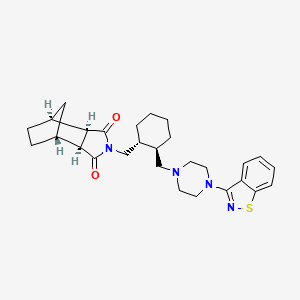
Pharmacotherapeutic group: Psycholeptics, antipsychotics. ATC code: N05AE05
Mechanism of action
Lurasidone is a selective blocking agent of dopamine and monoamine effects. Lurasidone binds strongly to dopaminergic D2- and to serotonergic 5-HT2A and 5-HT7- receptors with high binding affinity of 0.994, 0.47 and 0.495 nM, respectively. It also blocks α2c-adrenergic receptors and α2a-adrenergic receptors with a binding affinity of 10.8 and 40.7 nM respectively. Lurasidone also exhibits partial agonism at the 5HT-1A receptor with a binding affinity of 6.38 nM. Lurasidone does not bind to histaminergic or muscarinic receptors.
The mechanism of action of the minor active metabolite of lurasidone ID-14283 is similar to that of lurasidone.
Lurasidone doses ranging from 9 to 74 mg administered to healthy subjects produced a dose-dependent reduction in the binding of 11C-raclopride, a D2/D3 receptor ligand, in the caudate, putamen and ventral striatum detected by positron emission tomography.
Pharmacodynamic effects
In the main clinical efficacy studies, lurasidone was administered at doses of 37-148 mg lurasidone.
Clinical efficacy
The efficacy of lurasidone in the treatment of schizophrenia was demonstrated in five multi-centre, placebo-controlled, double-blind, 6-week trials in subjects who met Diagnostic and Statistical Manual of Mental Disorders, Fourth Edition (DSM-IV) criteria for schizophrenia. Lurasidone doses, which varied across the five trials, ranged from 37 to 148 mg lurasidone once daily. In the short-term trials, the primary efficacy endpoint was defined as the mean change from baseline to Week 6 in Positive and Negative Syndrome Scale (PANSS) total scores, a validated multi-item inventory composed of five factors to evaluate positive symptoms, negative symptoms, disorganised thoughts, uncontrolled hostility/excitement, and anxiety/depression. Lurasidone demonstrated superior efficacy compared with placebo across Phase 3 studies (see Table 2). Lurasidone showed significant separation from placebo from as early as Day 4. Additionally, lurasidone was superior to placebo on the predefined secondary endpoint Clinical Global Impression – Severity (CGI-S) scale. Efficacy was also confirmed in a secondary analysis of treatment response (defined as ≥ 30% decrease from Baseline in PANSS total score).
Table 3: Schizophrenia Adult Studies: Positive and Negative Syndrome Scale for Schizophrenia (PANSS) Total Score - Change from Baseline to Week 6- MMRM for Studies D1050229, D1050231, and D1050233: Intent-to-Treat Analysis Set
Study Statistic
Placebo
Lurasidone dose (b)
Active Control (a)
37 mg
74 mg
111 mg
148 mg
Study D1050229
Baseline Mean (SD)
LS Mean Change (SE)
Treatment Difference vs. placebo
Estimate (SE)
p-value
N=124
96.8 (11.1)
-17.0 (1.8)
--
--
N=121
96.5 (11.6)
-19.2 (1.7)
-2.1 (2.5)
0.591
N=118
96.0 (10.8)
-23.4 (1.8)
-6.4 (2.5)
0.034
N=123
96.0 (9.7)
-20.5 (1.8)
-3.5 (2.5)
0.391
--
--
--
--
--
--
--
--
--
--
Study D1050231
Baseline Mean (SD)
LS Mean Change (SE)
Treatment Difference vs. placebo
Estimate (SE)
p-value
N=114
95.8 (10.8)
-16.0 (2.1)
--
--
N=118
96.6 (10.7)
-25.7 (2.0)
-9.7 (2.9)
0.002
--
--
--
--
--
N=118
97.9 (11.3)
-23.6 (2.1)
-7.5 (3.0)
0.022
--
--
--
--
--
N=121
96.3 (12.2)
-28.7 (1.9)
-12.6 (2.8)
<0.001
Study D1050233
Baseline Mean (SD)
LS Mean Change (SE)
Treatment Difference vs. placebo
Estimate (SE)
p-value
N=120
96.6 (10.2)
-10.3 (1.8)
--
--
--
--
--
--
--
N=125
97.7 (9.7)
-22.2 (1.8)
-11.9 (2.6)
<0.001
--
--
--
--
--
N=121
97.9 (11.8)
-26.5 (1.8)
-16.2 (2.5)
<0.001
N=116
97.7 (10.2)
-27.8 (1.8)
-17.5 (2.6)
<0.001
(a) Olanzapine 15 mg in Study D1050231, quetiapine extended-release (XR) 600 mg in Study D1050233. N is number of subjects per model estimate.
(b) p-values for lurasidone vs. placebo were adjusted for multiple comparisons. P-values for olanzapine and quetiapine XR vs. placebo were unadjusted.
In the short-term studies there was no consistent dose-response correlation observed.
Long-term maintenance efficacy of lurasidone (37 to 148 mg lurasidone once daily) was demonstrated in a 12 month non-inferiority trial with quetiapine extended release (200 to 800 mg once daily). Lurasidone was non-inferior to quetiapine extended release in time to relapse of schizophrenia. Lurasidone had a small increase from baseline to Month 12 in body weight and body mass index (Mean (SD): 0.73 (3.36) kg and 0.28 (1.17) kg/m2, respectively) compared to quetiapine extended release (1.23 (4.56) kg and 0.45 (1.63) kg/m2, respectively). Overall, lurasidone had a negligible effect on weight and other metabolic parameters including total cholesterol, triglycerides, and glucose levels.
In a long-term safety study clinically stable patients were treated using 37 – 111 mg lurasidone or risperidone 2 – 6 mg. In that study the rate of relapse over a 12-month period was 20% for lurasidone and 16% for risperidone. This difference neared, but did not reach, statistical significance.
In a long-term trial designed to assess the maintenance of effect, lurasidone was more effective than placebo in maintaining symptom control and delaying relapse of schizophrenia. After having been treated for an acute episode and stabilized for a minimum of 12 weeks with lurasidone, patients were then randomised in a double-blind manner to either continue on lurasidone or on placebo until they experienced a relapse in schizophrenia symptoms. In the primary analysis of time to relapse in which patients that withdrew without relapse were censored at the time of withdrawal, patients on lurasidone showed a significantly longer time to relapse compared with patients on placebo (p=0.039). The Kaplan-Meier estimates of the probability of relapse at Week 28 were 42.2% for lurasidone and 51.2% for placebo. The probability of all-cause discontinuation at Week 28 were 58.2% for lurasidone and 69.9% for placebo (p=0.072).
Paediatric population
Schizophrenia
The efficacy of Latuda, was established in a 6-week, randomized, double-blind, placebo-controlled study of adolescents (13 to 17 years) who met DSM-IV-TR criteria for schizophrenia (N=326). Patients were randomized to one of two fixed-doses of Latuda (37 or 74 mg/day) or placebo.
The primary rating instrument used to assess psychiatric signs and symptoms was the PANSS. The key secondary instrument was the CGI-S.
For both dose groups, Latuda was superior to placebo in reduction of PANSS and CGI-S scores at Week 6. On average, the 74 mg/day dose did not provide additional benefit compared to the 37 mg/day dose.
The primary efficacy results are provided in Table 4.
Table 4 Primary Efficacy Results (PANSS Total Score) - Change From Baseline to Week 6- MMRM for the Adolescent Schizophrenia Study D1050301: Intent-to-Treat Analysis Set
Study Statistic
Placebo
Lurasidone dose (a)
37 mg
74 mg
Study D1050301
Baseline Mean (SD)
LS Mean Change (SE)
Treatment Difference vs. placebo
Estimate (SE)
p-value
N=112
92.8 (11.08)
-10.5 (1.59)
--
--
N=108
94.5 (10.97)
-18.6 (1.59)
-8.0 (2.21)
0.0006
N=106
94.0 (11.12)
-18.3 (1.60)
-7.7 (2.22)
0.0008
N is number of subjects per model estimate.
(a) p-values for lurasidone vs. placebo were adjusted for multiple comparisons.
The improvements in the CGI-S scores at Week 6 were significantly different from placebo for both the lurasidone 74 mg/day (-0.42 ± 0.130, adjusted p = 0.0015) and lurasidone 37 mg/day (-0.47 ± 0.130, adjusted p = 0.0008) treatment groups.
A 104-week extension study (Study D1050302) was designed to evaluate the long-term safety, tolerability, and effectiveness of flexibly dosed lurasidone (18.5, 37, 55.5, or 74 mg/day) in paediatric subjects who completed a 6-week treatment period in three preceding studies of various indications. Only results for 271 subjects with schizophrenia who enrolled from Study D1050301 are hereinafter presented. Of these, 186 subjects (68.6%) completed through 52 weeks and 156 (57.6%) subjects completed 104 weeks of flexible dosing with lurasidone 18.5 to 74 mg/day.
For subjects who continued from D1050301, the mean (95% CI) in PANSS total score from DB Baseline was-26.5 (-28.5, -24.5) at Week 28 LOCF, -28.2 (-30.2, -26.2) at Week52 LOCF, and -29.5 (-31.8, -27.3) at Week 104 LOCF/post-OL Endpoint, and mean change (95% CI) from OL Baseline was -9.2 (-11.1, -7.2) at Week 28 LOCF, -10.8 (-13.0, -8.7) at Week 52 LOCF, and -12.2 (-14.5, -9.8) at Week 104 LOCF/post-OL Endpoint.
Bipolar Depression
The short-term efficacy of lurasidone was studied in a 6-week multicentre, randomized, double-blind, placebo-controlled, study of children and adolescent patients (10-17 years of age) who met Diagnostic and Statistical Manual of Mental Disorders, Fifth Edition (DSM-V) criteria for a major depressive episode associated with bipolar I disorder, with or without rapid cycling, and without psychotic features (N=350). Patients were randomized to flexibly dosed lurasidone 18-74 mg once daily or placebo.
The primary efficacy endpoint was defined as the mean change from baseline to Week 6 in Children's Depression Rating Scale, Revised (CDRS-R) Total Score. The key secondary endpoint was Clinical Global Impression – Bipolar Version, Severity of Illness (CGI-BP-S) Depression Score. Statistically significant differences favouring lurasidone over placebo were shown for these endpoints for the total population studied, beginning at Week 2 and were maintained at each study visit through to the end of the study. However, the primary and key secondary efficacy endpoints were not met in younger patients (below 15 years of age). Placebo-adjusted LS mean change (95% CI) from Baseline to Week 6 LOCF in CDRS-R total score for the lurasidone group was -1.8 (-5.6, 2.0) for subjects in the 10- to 14-year-old age patients and was -8.6 (-12.4, -4.8) for subjects in the 15- to 17-year-old age patients (Table 5).
The safety profile of lurasidone in children included in this short-term study is in general consistent with that observed when treated within the approved indication in adults, however, differences in frequency of the most commonly occurred adverse reactions have been observed in paediatric patients for nausea (very common), diarrhea (common) and decreased appetite (common), compared with adults (common, unknown, and uncommon, respectively).
Table 5 Bipolar Depression Paediatric Study: Children's Depression Rating Scale, Revised (CDRS-R) Total Score and Clinical Global Impression-Bipolar Version, Severity of Illness (CGI-BP-S) Depression Score (Depression) - Change From Baseline to Week 6 - MMRM for Study D1050326: Intent-to-Treat Analysis Set
Parameters
Study Statistic
Placebo
Lurasidone dose 18.5-74 mg
(a) (b)
Primary Endpoint: CDRS-R Total Score
N=170
N=173
Baseline Mean (SD)
58.6 (8.26)
59.2 (8.24)
LS Mean Change (SE)
-15.3 (1.08)
-21.0 (1.06)
Treatment Difference vs. placebo
Estimate (SE; 95% CI)
--
-5.7 (1.39; -8.4 to -3.0)
p-value
--
<0.0001
Key Secondary Endpoint: CGI-BP-S Depression Score
N=170
N=173
Baseline Mean (SD)
4.5
4.6
LS Mean Change (SE)
-1.05 (0.087)
-1.49 (0.085)
Treatment Difference vs. placebo
Estimate (SE; 95% CI)
--
-0.44 (0.112; -0.66 to -0.22)
p-value
--
<0.0001
N is number of subjects.
(a) p-values for lurasidone vs. placebo were adjusted for multiple comparisons.
(b) Lurasidone doses of 18.5, 37, 55.5, 74 mg are equivalent to 20, 40, 60 and 80 amounts of lurasidone hydrochloride.
⚠️ Warnings
Any unused medicinal product or waste material should be disposed of in accordance with local requirements.